Download Mar 2025 PDF file
CALGAROO

A journey into nature

Newsletter of the Parramatta and Hills District Group

Australian Plants Society NSW Ltd

Our vision: inspiring people to admire, grow and conserve native plants
WHAT’S ON IN 2025
| 22 March Saturday 2pm: | Members’ meeting Gumnut Hall Speaker Pat Schwartz “Hills-Hornsby Koala project” |
| 26 March Wednesday 10am: | Propagation |
| 23 April Wednesday 10am: | Propagation |
| 26 April Saturday 2pm: | Bushwalk Brush Farm Eastwood. Leader Jennifer Farrer |
| 21 May Wednesday 10am: | Propagation |
| 24 May Saturday: | Bushwalk Waterfall Walk West Pennant Hills. Leader Jennifer Farrer |
| 18 June Wednesday 10am | Propagation |
| 28 June Saturday 2pm: | Members’ meeting Gumnut Hall Speaker Brian Roach “Amazing Greys” |
| 16 July Wednesday 10am: | Propagation |
| 26 July Saturday: | Bushwalk Jones Road Fire Trail Kenthurst |
| 23 August Saturday: | Visit Boongala Gardens Kenthurst |
| 27 August Wednesday 10am: | Propagation |
| 24 September Wednesday 10am | Propagation |
| 27 September Saturday: | Visit to Muogamarra NP |
| 22 October Wednesday 10am | Propagation |
| 25 October Saturday: | Bushwalk Agnes Banks/ Castlereagh Nature Reserve. Leader Daniel McDonald |
| 19 November Wednesday 10am | Propagation |
| 22 November Saturday | Members’ meeting and end-of-year celebration, Gumnut Hall. |
| 17 December Wednesday 10am | Propagation |
If you’d like to come to our propagation days at Bidjiwong Community Nursery and haven’t been before, you can get details from Lesley Waite – phone 0438 628 483
* * * * * *
Members’ meeting Saturday 22 March at 2pm
Gumnut Hall, Gumnut Place Cherrybrook
Topic: The Hills Hornsby Rural Koala Project
Linda Pine
For our March meeting, we’ll have our own local Koala advocate Pat Schwartz of the Hills Hornsby Rural Koala Project (HHRKP) to share with us their ongoing actions to have our local Koala populations recognised and protected.
We will discover how best to locate a Koala.
You may see them curled up in the fork of a tree or wandering along a track, or you may spot other evidence of their presence with scat below a local habitat tree, BUT, can you tell the difference between the scat of a Koala or a brushtail possum?
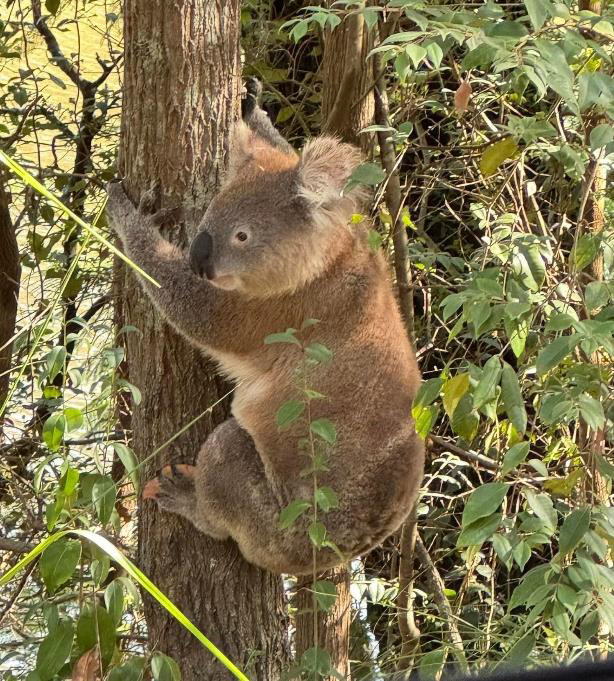
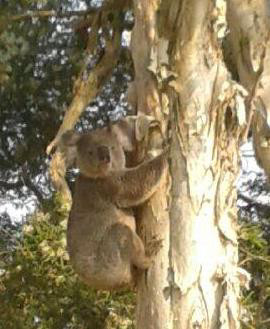
Do you know what their preferred habitat trees are?
Join us when we discuss such matters, their habitat requirements, and where they have been verified in our local areas by thermal drones. These drones have shown that both The Hills and Hornsby shires have confirmed populations of Koalas.
By learning more, we can help HHRKP locate Koalas when we are out in the bush and protect these valuable habitats and all the biodiversity contained within them.
The involvement of the community is vital in our quest to have the local Hills Hornsby Koala population recognised and protected.
Morphology matters
John Knight
Edited version from the Isopogon & Petrophile Study Group Newsletter 34, April 2024
What is morphology?
This derived from Greek (morphe) referring to form, and (logos) to research or study, and in relation to plants, is the study of external features and characters that we can recognise and differentiate. From this, we shape our notions of where a particular plant sits within the structure of plants worldwide. By studying these various characters, we can make choices as to what a particular plant might be, and by observing these readily discernible features we can learn to recognise, and then identify a plant. Note that the terms used to describe characters are understood by all botanists and plant people worldwide.
Why is this important?
There is a long history of classification based on plant morphology. Plants have been recognised for thousands of years based on their usefulness. Ancient civilisations based their classification on uses, such as food, medicine and even poison.
The Greek philosopher Theophrastus (c.371-287 BCE) classified around 480 plants based on their growth forms, such as trees, shrubs, and herbs, and noted differences in reproductive structures. Whilst such classifications worked for centuries, explorers were beginning to return to Europe from far-flung corners with vast collections of new plants unknown to modern science, and therefore needing sorting into workable groupings.
17th century plantsman, England’s John Ray produced in 1690 the publication “Synopsis methodica” which laid down rules for a modern system of nomenclature. It was he who first used the term botany (from the Greek botane = plant) to describe the subject of his life’s work. He introduced the concept of species, and developed the first natural system based on overall similarities. His 1703 edition of “Methodicus plantarum” included 18,000 taxa.
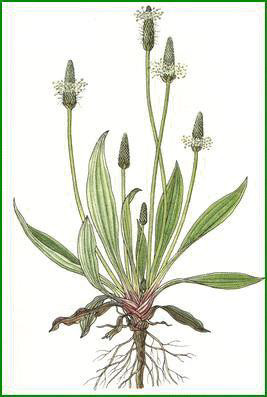
Plantago foliis ovato-lanceolatis pubescentibus spica cylindrica scapo tereti tells us that this plant (pictured below) is a plantain, with ovate-lanceolate leaves becoming softly hairy, with a cylindrical flower head and a rounded stem. Whilst such a description might be acceptable when only a relatively small number of plants needed description, this system was proving unwieldy when applied to the many thousands of plants now arriving from around the world. A new, more efficient system was needed.
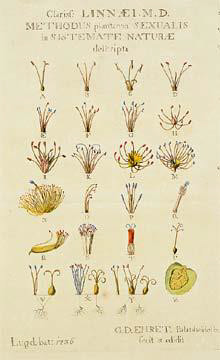
Recognised as the father of modern taxonomy, Carl von Linne (Linnaeus) published the first of his works in 1737. Systema Naturae detailed his concept of sexual classification based on floral structure, as depicted in the illustration (below). Literally, the System of Nature, through three kingdoms of nature, according to classes, orders, genera and species, with characters, differences, synonyms, places. (Wikipedia).
In 1753, Linnaeus published “Species plantarum” which described 6,000 plants known to European science, basing the work on the sexual parts of plants. Part of this work describes plants with five stamens and one ovary, Heliotropium europeum, foliis ovatus integerrimis tomentosis rugosis, spicis conjugatis, saying this Heliotropium has ovate leaves which are entire and wrinkled, with flowers connected in spikes. It is worth noting that Linnaeus placed the specific epithet europeum in the margins of the page, as it was intended that this would enable easier indexing of the work.
Photo: Wikipedia
The science of classification
Taxonomy derives from the Greek taxis, meaning arrangement, and nomia, the method or distribution, from the verb nemein to manage, and its root nem, to assign, and is the science of classification. ‘Quidquid latine dictum sit, altum videtur’, or ‘Anything said in Latin sounds profound’. Latin is the universal language of science for the very good reason that it is considered a ‘dead language’, meaning no new names or slang are used, created or changed through the years. So even if we may find the descriptions difficult, or profound, there is a very valid reason to maintain the tradition.
Taxonomic classification provides a standardised and universally accepted system for organising plant diversity. Taxonomic classification groups plants in families, e.g. Proteaceae which have common characteristics suggesting they may have evolved from a common ancestor. Genera with similar traits are grouped in families, whilst similar species are grouped in genera. The basic requirement of biological classification is showing a true genetic relationship.
Phenotypic classification (plant morphology) has several advantages for those interested in plants. These include simplicity, ease of observation and accessibility. It is particularly useful for observing plants in the wild, to assist with recognition, or in the laboratory for identification. Phenotypic traits may be influenced by environmental factors, and as such leaves may be smaller or larger than typical, but the floral structure does not alter.
It is worth noting that the first published work on Australian plants, Flora Australiensis, was the result of many years of work by English botanist George Bentham. Although he never visited Australia, he had access to all the herbarium collections held in Europe, and he was encouraged by Joseph Hooker of Kew. He also received all the collections of Australia’s first permanent taxonomist, Ferdinand Mueller. Published in seven volumes, from 1863 to 1878, the work provided identification keys for 8,125 species, and was the first completed flora of any large continental area. The Flora is based on morphological characters, but is arranged according to perceived evolutionary history.
Being able to recognise the physical features of plants, and with these clues then identifying what a plant is, or might be, is a learned skill that makes growing plants challenging but rewarding. This knowledge also makes our bush rambles so much more satisfying. So, despite the move towards using DNA sequencing to determine genetic relationships, which requires serious laboratory equipment and techniques, I believe we are well served by understanding the various physical clues and features that allow us to say that Morphology Matters!
Creating a native cottage garden
From the Australian Native Plants Society (Australia) website
Have you ever wondered how to go about creating a cottage garden with native plants?
The idea of a cosy cottage garden, with herbaceous borders of annuals and perennials against a backdrop of shrubs and (maybe) a small tree or two, has always been popular. Nowadays smaller gardens continue to make this style popular.
In this story, we share which plants might work for creating a native cottage garden.
The outcome will be a more beautiful garden, as well as one that is more sustainable, more attractive to local fauna and insects and less chance of weeds escaping into the bush.
What is a cottage garden?
Cottage gardens have existed for thousands of years. There was a resurgence in the late 1800s, a reaction to the highly formal gardens of those times. Some believe they originated in the 1300s when food became scarce requiring people to become more self-sufficient. Small plots of land were dedicated to growing vegetables, fruit, herbs and flowers.
Cottage gardens can nowadays be quite large, as evidenced by Monet’s garden in France, with its narrow meandering pathways and sprawling and highly colourful plants spilling over.

Massive spring flowering in a native cottage garden, Hunter Valley. (Heather Miles)
Features of cottage gardens
In creating a native cottage garden, there are a few features to be aware of:
•Mass plantings of low-growing shrubs capitalising on colour and texture
•Plants all tangled together and co-mingling
•Seasonal displays of colour – these gardens are a riot of colour for much of the year
•Practical and have a sense of ‘organised disarray’, as Diana Snape put it
Planting an Australian native cottage garden
Australia has more native plants than any other country in the world. Many low-growing annual and perennial Australian plants and shrubs can be used in a massed display to create a cottage garden. There are many colours and we are fortunate to have an abundance of blues to choose from.
The principles of colour
You can use a colour wheel to choose colour harmonies or just go for a riot of colour. The choice is all yours and will be reflected in the character of your garden. Many books have been written on using colour in the garden. Colour is instrumental in creating the mood in your garden.
Here is a continuous colour wheel:

When choosing flower colours here are a few points:
Warm colours – red, pink, orange and yellow. These give a sense of fun and activity. They come to the foreground and thus appear larger.
Cool colours – blues, greens and some blue-violets give a feeling of space and serenity; they tend to recede from the eye and can appear smaller.
Neutral colours – white, grey and black. Grey is an excellent ‘linking’colour. Be careful with white and black, both can appear as holes or spaces in a colour scheme. Both work well as highlighters of other colours.
Limit the number of contrasting colours. They are high impact so they should be used sparingly to create a focal point in your garden.
Use more of the harmonious colours. They lie next to each other on the colour wheel. They are closely related on the colour wheel and do not clash.
To read the rest of this story please click here.
Interesting links . . .
A story of restoring hope – Lake Pedder.
While you sleep, these insects work hard on the night shift to keep our environment healthy – from The Conversation.
Bee hunter saving native species, one ‘hotel’ at a time – from The ABC.
Rescuing our endangered plants – from Ku-ring-gai Council.
Unbelievable renaissance of rare cloud forest as unique species reclaim paradise – from The ABC. An amazing story about Lord Howe Island!
What the heck is a slime mould? – from The ABC
University of Queensland researchers say study could show how rainforests will react to climate change – from The ABC
Koala counting project finds ‘strong case’ of unrecognised population in Hills district – from The ABC.
Beautiful Banksias!
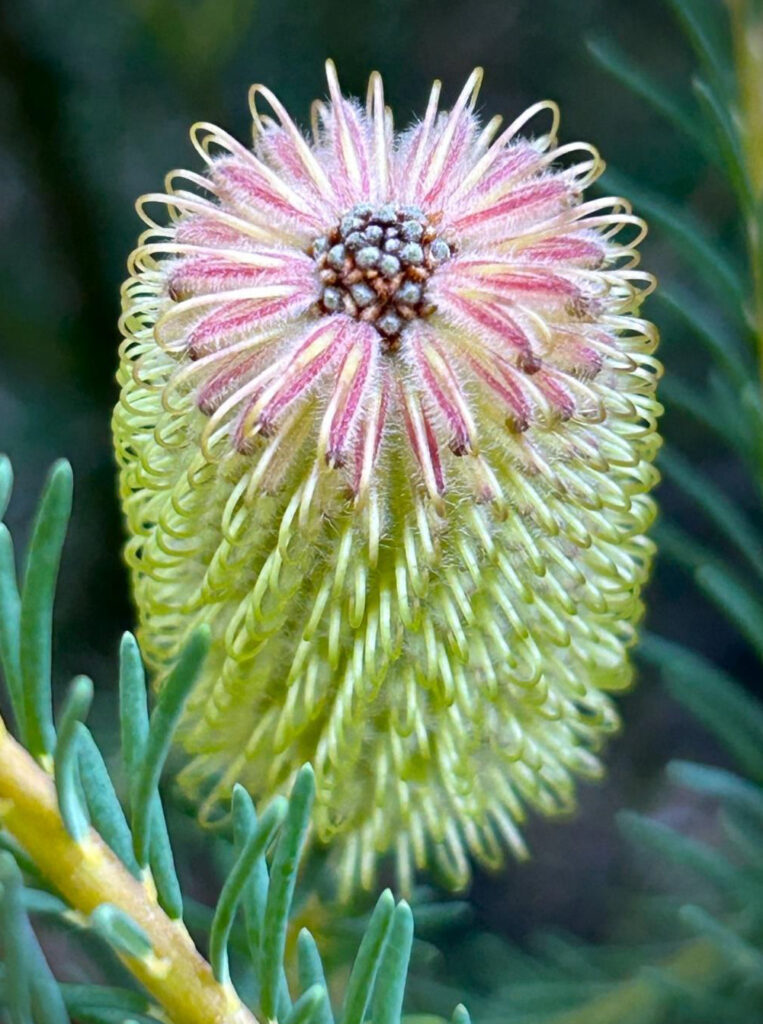
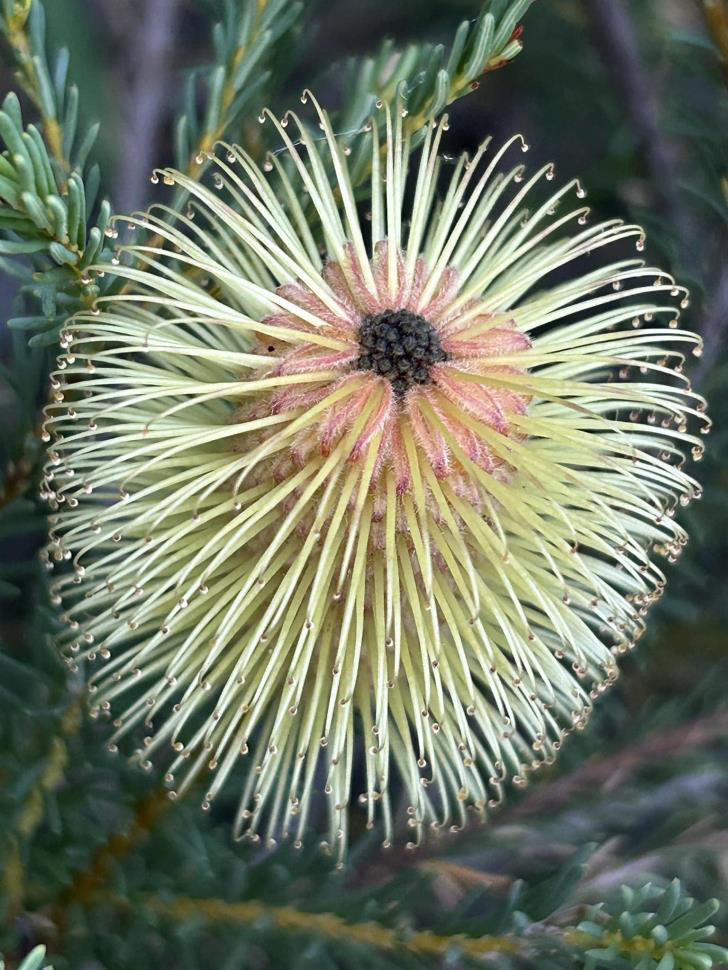
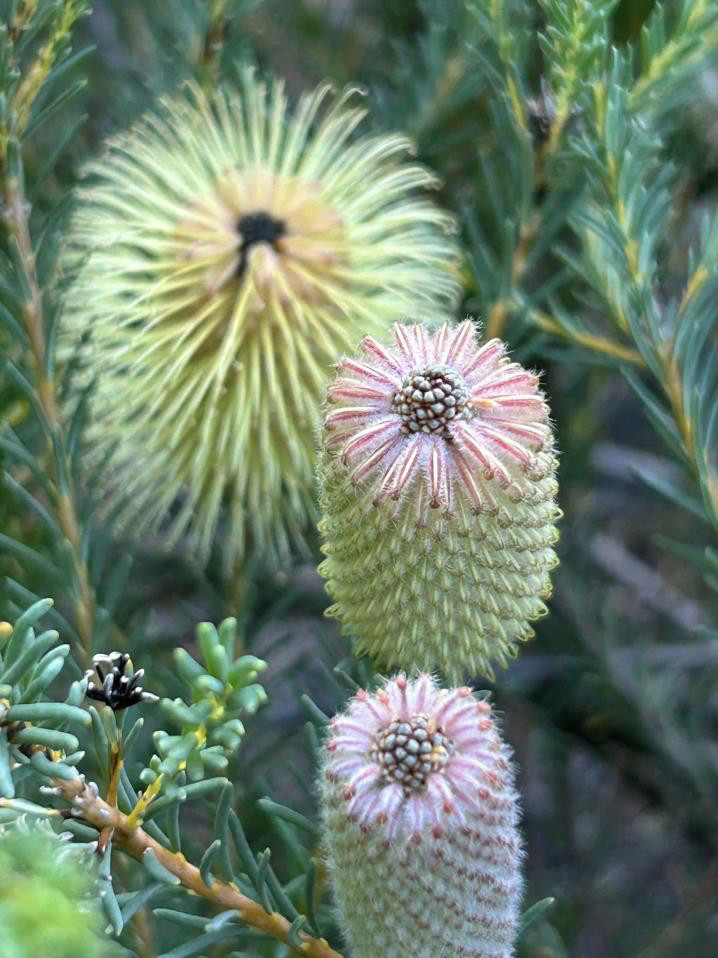
Banksias never cease to amaze.
These photos by Karlo Taliana are of Banksia pulchella.
It has been growing happily and flowering well in Karlo’s garden at Georges Hall, Sydney, for about eight years, despite that it hails from south-west WA.
It’s a grafted plant about 1.5m x 1.5m
Exquisite!
Karlo is an administrator of the Banksia Lovers Facebook Group where these photos first appeared.
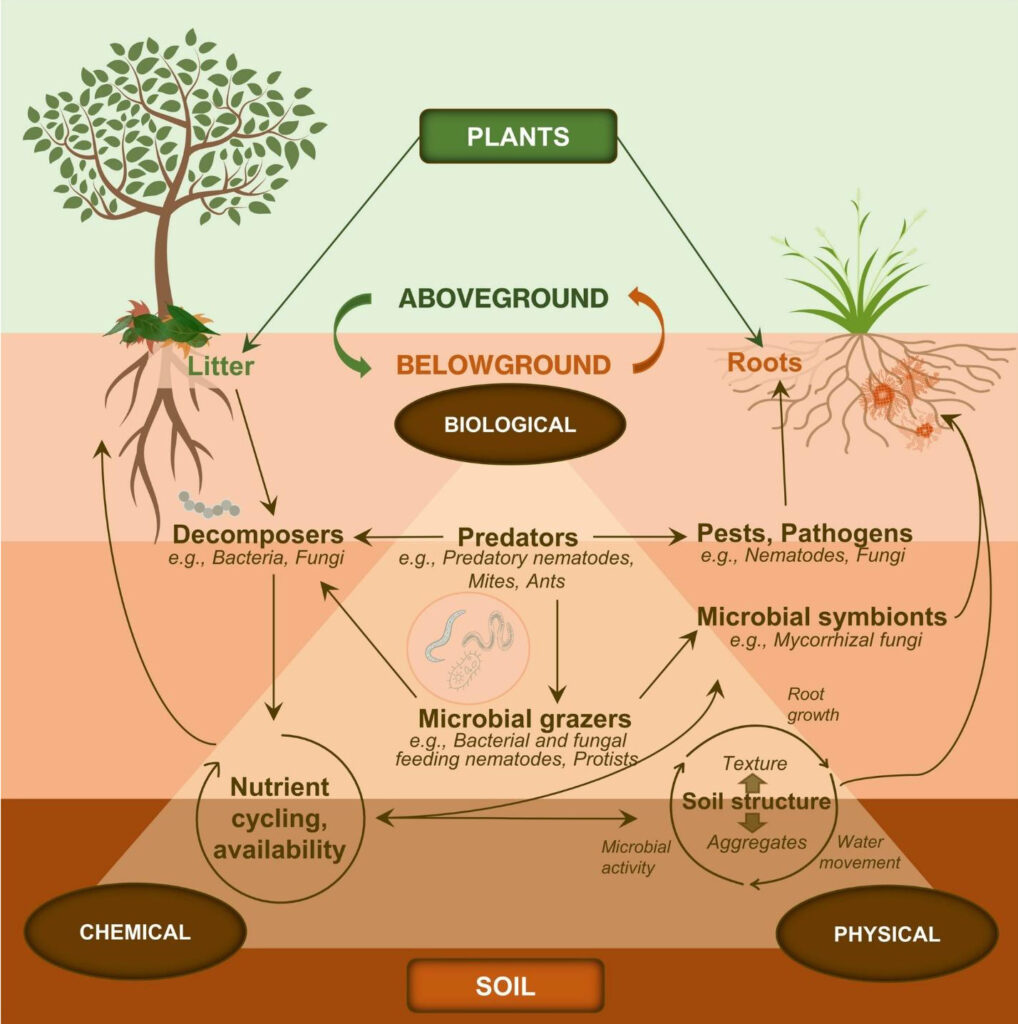
Interactions between aboveground and belowground processes in an ecosystem.
Plants, through both their litter and roots, influence the interconnected physical, chemical and biological soil processes, contributing to the nutrient pool and influencing belowground organisms and soil structure. At the same time, this belowground process supports plant growth and various ecosystem functions. Soil decomposers, microbial grazers (i.e., bacterial and fungal feeding microfauna including nematodes and protists), predators (including predatory nematodes, mesostigmatid mites and ants) and symbionts, pests and pathogens influence various chemical (e.g., breaking down organic matter and contributing to nutrient cycles and availability) and physical (e.g., supporting root growth and affecting soil structure) processes.
Restoration outcomes can be improved by better understanding how these interactions regulate ecosystem structure and function and then implementing interventions to steer recovery.
From the Journal of Sustainable Agriculture and Environment under Creative Commons.
The latest Australian Flora Foundation newsletter, Research Matters, for January 2025 is now available. If you’d like a copy, please let me know (itcox@bigpond.com) and I’ll send it to you.
Restoring and improving a portion of Kenthurst bushland
Erica and Jim Nash. February 2025
It has been a long-held objective on our 2-hectare (20,000m2) block of Kenthurst bushland to restore sections that have been gradually overrun by native Blady Grass (Imperatum cylindrica) and to a lesser extent introduced weeds.
A compounding problem has been the management of storm rain flows which have scoured out soil and contributed to the spread of weeds.
The native Swamp Wallaby (Wallabia bicolor) is abundant and readily grazes on growth tips.
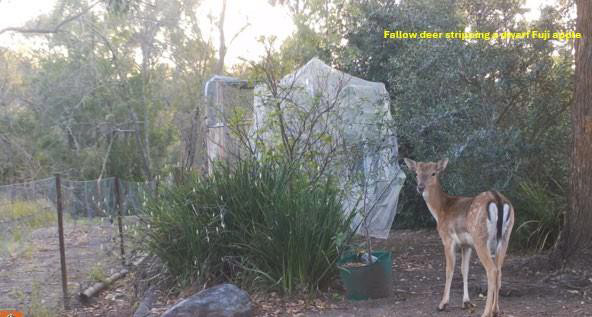
The feral Fallow Deer (Dama) is increasing in numbers. It can be a delicate feeder on growth tips but also has been determined to knock over and trample ring fencing when it really takes a fancy to something. The deer have also been observed to tear small branches off the likes of Persoonias.
This article deals solely with a section at the bushland margin where the objectives have been:
o The removal of Blady Grass,
o Planting of native species not necessarily endemic to this part of Kenthurst,
o Mulching heavily,
o Implementing stormwater control measures, and
o Ring fencing to protect plantings from Swamp Wallabies (Wallabia bicolor) and feral Fallow Deer (Dama).
Starting with the Propagation of Endemic Native Plant Species
We endeavour to propagate species from our bushland, usually from seed and occasionally from cuttings.

Storm Water Management was a Major Focus
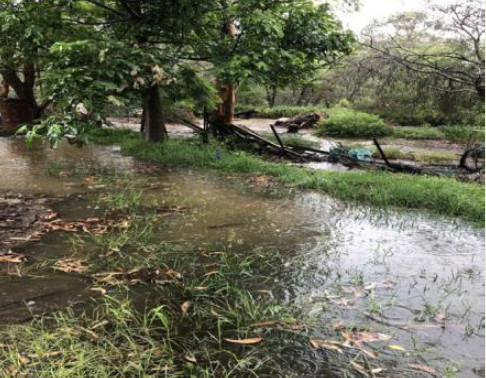

Inside the fence which separates the house block from the bushland a large swale holds back the storm water. If there is no overflow the detained water gradually soaks through to the sandstone shelf below and into a secondary detention basin. The Blady Grass is shown in the background.
Starting with the Secondary Detention Basin
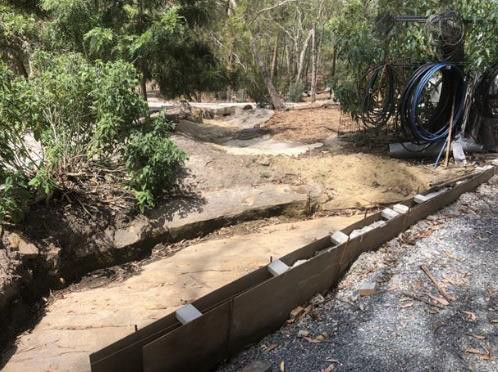
This was initially filled with silt. When dug out it revealed the sandstone shelf that extends under the swale inside the fence.
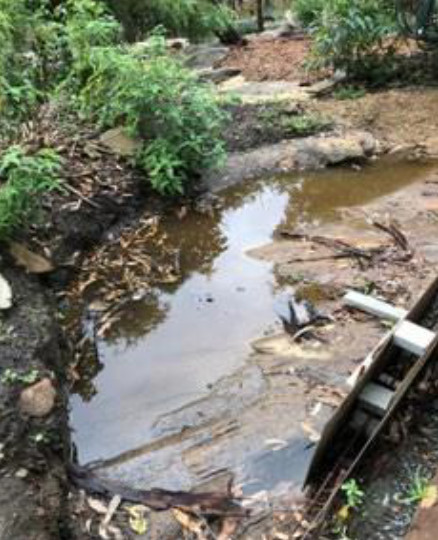
A concrete wall with weep holes has yet to be completed. A gravel path will be back filled against the wall the combination of these two factors ensuring good drainage.
Building the Contained Watercourse
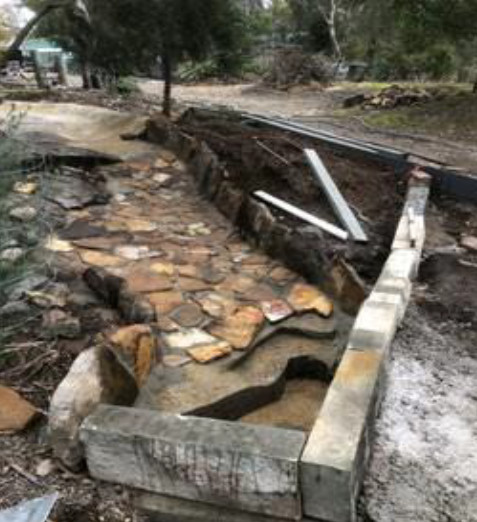
Progress on the watercourse sourced from the secondary
detention basin.
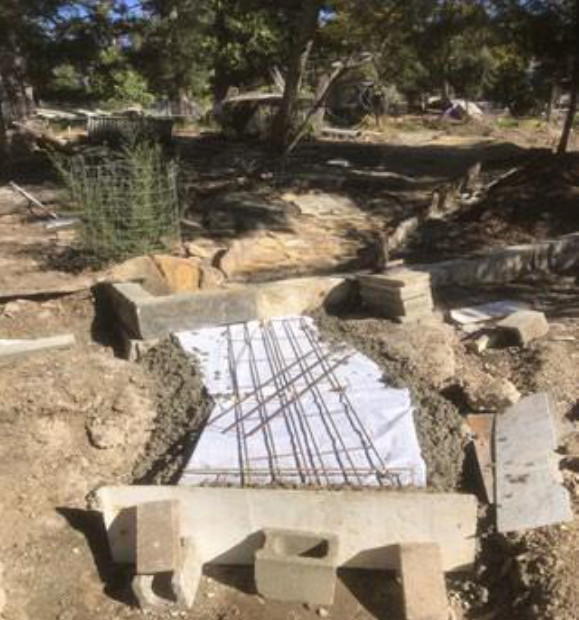
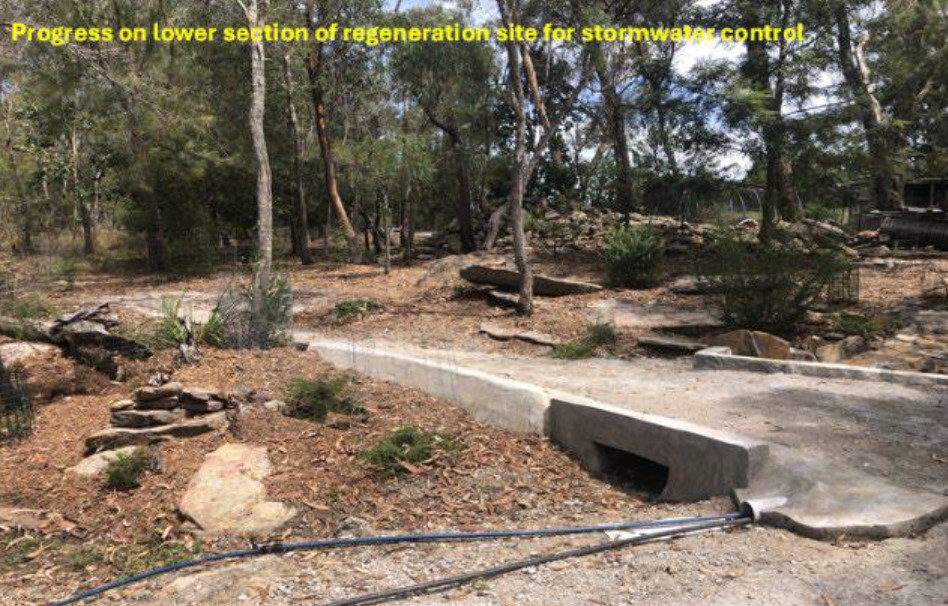
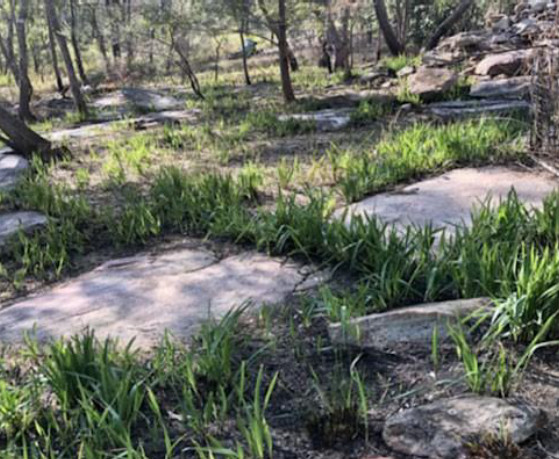
The next phase was to work across the lower section of the regeneration plot to enhance ease of access.
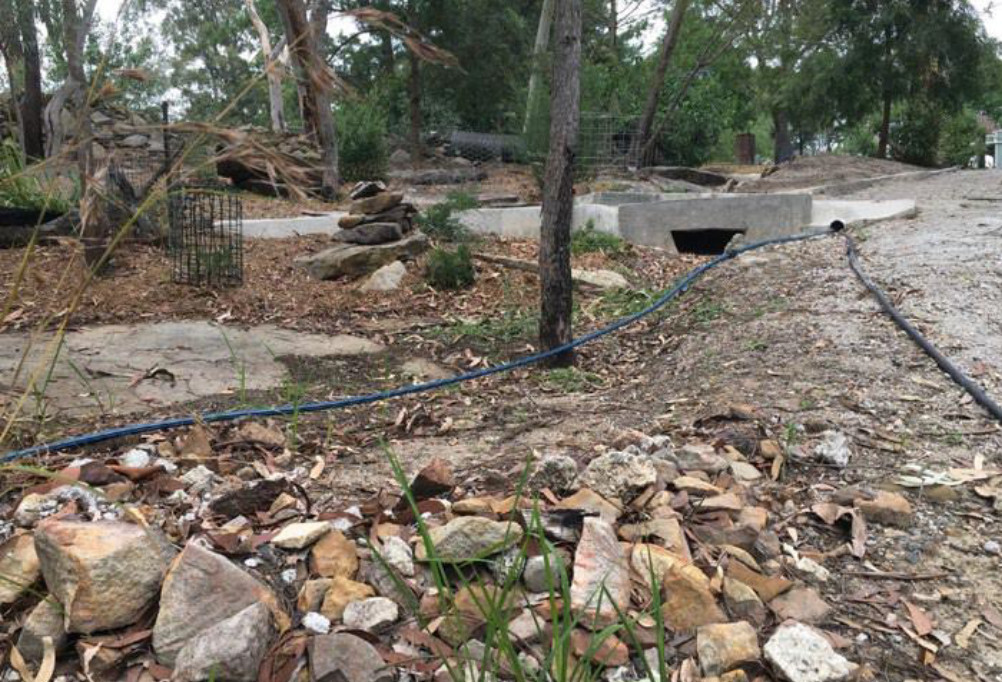
A series of loose rock walls were positioned to moderate the flow of water before it entered the bushland. This has proven effective in restricting erosion and the transport of unwanted seeds.
Removal of the Blady Grass (Imperatum cylindrica)
The whipper-snipper slashed blades were allowed to dry out and then put on an approved pile for burning.
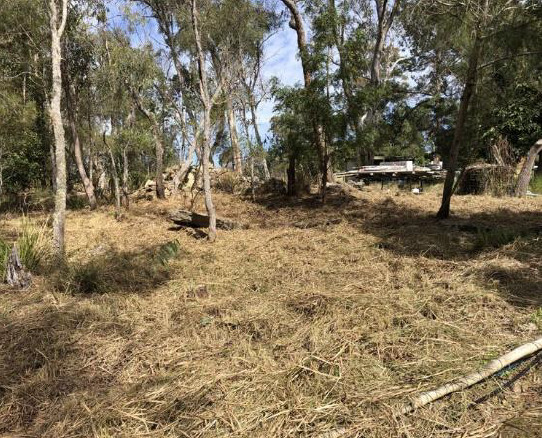
Regrowth of Blady Grass from runners.
After surveying the various herbicides used by farmers to control Blady Grass it was decided to use glyphosate. Two follow-up applications were required for total success.
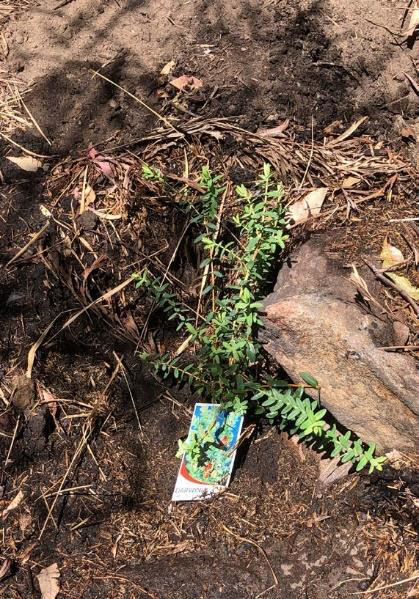
Planting and Ring Fencing
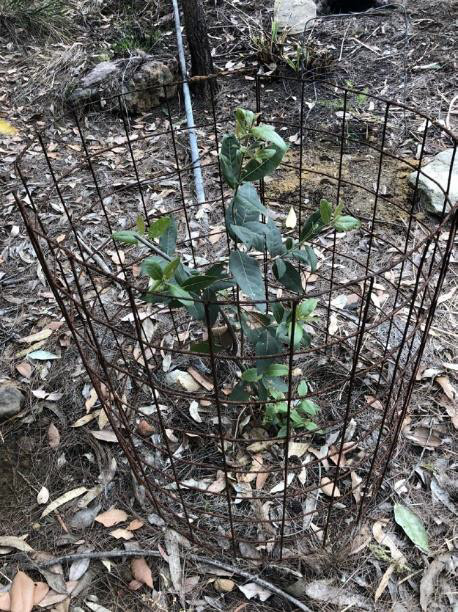
Ring fencing of different strengths according to susceptibility to grazing.
Some plants do not get touched.
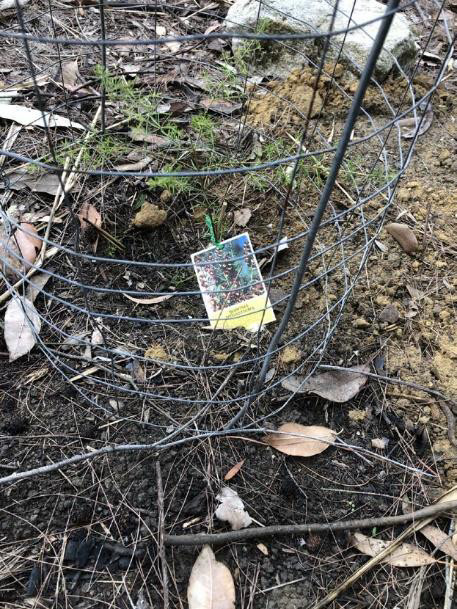
Contending with Swamp Wallabies and Fallow Deer
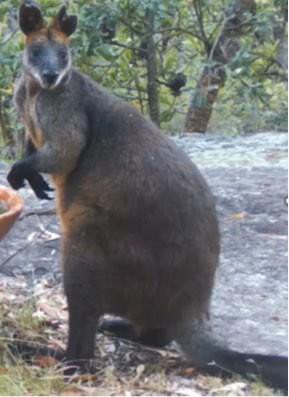
The Swamp Wallabies graze on the tender new growth. To get to it they use their forepaws to pull vegetation to them and at times will lean on and pull the ring fencing.
The Fallow Deer are more destructive because of their size and will sometimes bite on a branch and tear it off.
This Fallow deer and a companion (not shown) jumped the house block fence and grazed on fruit tree leaves, the fruit and rose bushes.
Invasive Species
On 25 February 2025, Andrew Cox gave the opening Keynote Address at the Annual Forum of the Invasive Species Council of British Columbia, in Vancouver, Canada.
This is taken from the program:
KEYNOTE PRESENTATION: Aussie successes in tackling invasive species. Andrew Cox, Chief Executive Officer, Invasive Species Council of Australia
Invasive species are the leading driver of Australia’s biodiversity loss and decline. The growing influence of the 23-year-old Invasive Species Council of Australia has resulted in big shifts in how governments and communities address this major threat. This presentation shares successful strategies that have led to its recent achievements, including a billion-dollar investment in red fire ant eradication, political support for aerial control of feral horses, overcoming hunter opposition to feral deer control, strong action preparing for deadly avian influenza and building institutions that address environmental biosecurity.
Using social research to better communicate about invasive species
In 2022, the Invasive Species Council of Australia commissioned Essential Media Communication to conduct an extensive social research project using a large-scale survey and focus groups to identify attitudes to invasive species and their management in Australia. The research helped identify language and narratives that generate support for invasive species control methods. Detailed topics explored included horses, cats, deer, invasive plants and the use of citizen science. This presentation summarises the research results, including how to communicate about invasive species effectively, and gives examples of where it was successfully applied.
About Andrew
Andrew has been motivated to act on invasive species after seeing the natural areas he regularly visited slowly taken over by invasive animals and plants. Early in his career he worked for the NSW National Parks and Wildlife, and led an NGO advocating for protected areas. Over the last 12 years, Andrew Cox has served as CEO of the Invasive Species Council of Australia, an independent environmental organisation dedicated to addressing the environmental impacts of invasive species. In this time the organisation has grown from 3 part-time staff to a highly influential and respected national advocate with an annual income of over $3 million and 120,000 supporters. Andrew is currently a member of the National Biosecurity Strategy Implementation Committee and National Biosecurity Funding Advisory Panel and co-founded the Australian Biosecurity Symposium and the Decade of Biosecurity Initiative. He will step down as CEO in March 2025.
What do you think the next 20 years of invasive species management will look like?
As invasive species threats continue to grow and biodiversity declines, we will increasingly need community support to act. Achieving this social licence will allow governments and politicians to make difficult decisions and harness the power of individuals. This will be supported by breakthroughs in technology, innovative techniques, biocontrols and genetic controls. Success will need deep collaborations, an aware and engaged community and strong advocacy.
If you had to explain your work with invasive species to a 6-year-old (Australian), what would you say?
We’re working hard to stop the arrival of the next cane toad. This means all of us acting responsibly when we travel and shop and governments putting in place strong rules and running preventive programs. We’re successful when the wild things in nature we all love are not replaced by plants and animals from other parts of the world
Jennifer spoke to us about this tour at our meeting at Gumnut Hall on 22 February 2025:
Wimmera ANPSA Tour October 2024
Jennifer Farrer
The Australian Native Plant Societies of Australia hold a conference every two years in one Australian state. Last year the conference was held in Melbourne and tours to Wilson’s Promontory and the Wimmera and Grampians were offered to delegates before and after the conference. These are two of the most beautiful parts of Victoria with amazing plant diversity and areas which I often visited when I lived there. I hadn’t been to The Grampians since moving to Sydney and I had never been to the Wimmera so this tour was an easy choice.
The tour was organised by the Wimmera Growers of Australian Plants. We had two coach captains from the Group, Harvey Champness and his partner Rae Decker who were with us for the entire tour and looked after all the logistics brilliantly.
Woorndoo Grasslands
You may remember from your schooldays the account of Major Mitchell’s expedition to Western Victoria where he marvelled at the superb landscape and immediately saw its potential for pastoral expansion. He named it Australia Felix and within 15 years European settlers and their herds had already started to destroy a land system nurtured by the indigenous inhabitants over millennia.
When he returned years later, he was dismayed to see the destruction of waterways and erosion caused by so many hard-hoofed animals.
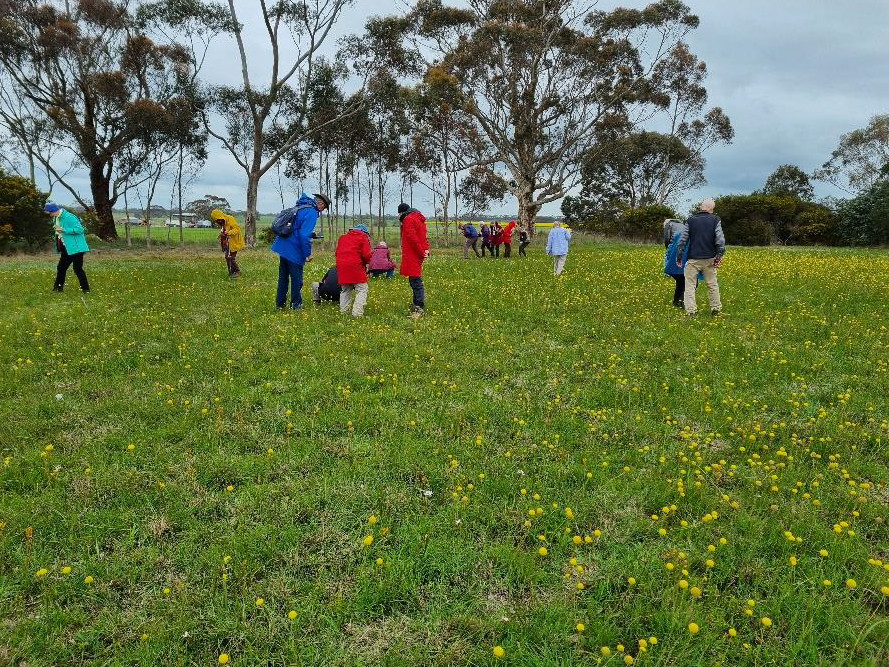
The good news is that nearly 200 years later remnant grasslands have survived in the Woorndoo Common and Cemetery and along the adjacent Three Chain Road.
The Three Chain Roads remain in some
parts of rural Victoria from the era when stock were driven to market sometimes over long distances.
Grasses are the dominant species but the gaps between the tussocks support a rich diversity of plant life such as sundews, lilies, orchids and daisies. What I thought was going to be a dreary day (it did rain some of the time) looking at grasses turned into a fascinating afternoon searching and discovering an amazing diversity of forbs and orchids.
The grasslands are managed today in similar ways to those used by the traditional owners. They are burned periodically to open up the spaces between the tussocks to allow light in, which allows the forbs and grasses to germinate after rain. The fairly open habitat encourages ground-dwelling animals such as the Plains Wanderer.
The Grampians
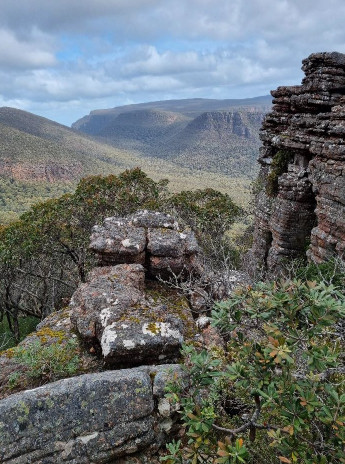
The indigenous name is Gariwerd.
They are a diversity hotspot with over 1300 native species. They were formed during the Ordovician and Silurian periods when a large inland lake bed of deep sands and gravels was upifted creating a series of steep-sided ranges with steep cliff lines along the east and gentle slopes to the west. Extensive erosion and deposition of shallow to deep beds of sands and gravels surrounding the ranges has resulted in numerous habitats for plants to colonise such as sub-alpine woodlands, rocky ridges, fern gullies, ridgetops, heathland and tall forests. The ranges run from south to north and there is a wide variation in rainfall. In addition, the Grampians Ranges are isolated from other ranges in Victoria. Each of these vegetation types supports its own unique flora. There are over 75 endemic species.
Our guide for the two days in The Grampians was Neil Marriott a horticulturist and conservationist who is more widely known in Australia as the co-author of the definitive three-volume work on Grevilleas. His property Panrock Ridge at Stawell houses the Plant Trust Australia official Grevillea collection with more than 330 species. (More about this later). No one knows more about the Grampians species than he does. It was a great privilege to have him take us on several walks in the Grampians.
The Wimmera
The flat to gently undulating plains in Western Victoria were named by Major Mitchell after the indigenous name for the river that flows through the area to the sea. The plains have been largely cleared for agricultural use particularly wheat although there is greater diversity in the crops being planted now such as canola, lentils and fava beans. The climate is similar but not the same as a Mediterranean climate with winter and spring rainfall and hot summers where temperatures reach 35 -40 maxima. Frosts are quite common up until November. The rainfall is quite low ranging from 550 to 350mm. (Sydney’s average is 1200mm). Last year was a year of very low rainfall.
The region is crossed by large fields of sand dunes preserved in The Little Desert and Big Desert. The Grampians and Mt Arapiles are the highest outcrops in the east.
Our guides for the Wimmera were Graham and Maree Goods. Maree was one of the five women who organized the Melbourne conference. She has published a book about the Little Desert and Graham was a guide at the Little Desert Nature Lodge (recently destroyed by bushfires) for twenty years.
Mt Arapiles
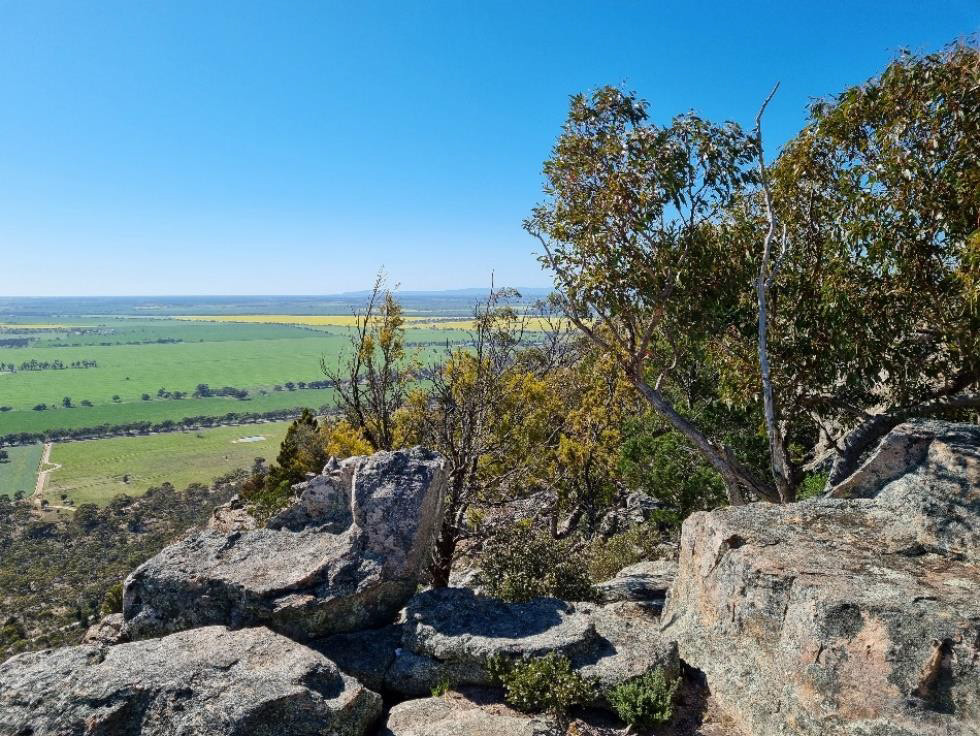
Situated 35 km west of Horsham, it is an outcrop of hard quartzose sandstone composed mostly of silica and dates from the Devonian period 400 million years ago.
The main attraction is rock climbing. The rock is very stable and safe for climbing. There are more than 3,000 climbs of every grade. Climbers visit from all over the world.
We took the asphalt road to the summit where there were views to The Grampians and the Wimmera Plains. There was a wide variety of plants growing out of the rocks.
The Little Desert
The Little Desert is located west of Horsham and extends to the South Australian border. Its annual rainfall of 300 -555mm per year is too high for a true desert but the poor sandy soil explains the name. Most of the interior of the park can only be accessed by 4WD. We visited the Cooack Road area which is accessible with a conventional vehicle.
Most years some parts of the desert will experience fires, usually caused by lightning. This year has been more destructive than most. The flora and fauna of the park cope reasonably well with fire except for the Mallee Fowl which requires large quantities of litter to build its breeding mounds.
The months June through to November is the peak flowering time. We saw daisies, orchids and lilies as well as the rare Spyridium ferculentum which is only found in the Cooack Road part of the park.
Deep Lead Nature Conservation Reserve (Stawell Ironbark Forest)
Gold was mined in this area as it was in many parts of Victoria. The landscape here has been turned over in the quest for riches. It is now one of the most important conservation sites in Victoria because of the presence of several endangered species. The dominant species is Red Ironbark (Eucalyptus tricarpa subsp. tricarpa) also known as Mugga. The understorey is dwarf sheoaks. (Allocasuarina species).
Wimmera Gardens
The low rainfall and sandy soil provide challenges for local gardeners. The rainfall decreases from southwest to northeast. The higher rainfall areas have more acidic soils whereas more alkaline soils dominate the northern plains. Drainage can be a problem in wet years. These conditions are perfect for growing some of the more spectacular plants from Western Australia as well as species endemic to the area.
Royal Mail Hotel Dunkeld
The Royal Mail is famous for its food and attractive location at the southern end of The Grampians. In 2006 bushfires ravaged the Northern Grampians and destroyed much of Neil Marriott’s garden. He and his wife Wendy moved to Dunkeld for two years and amongst other projects redesigned the hotel garden. The most spectacular plant was Electric Velvet – a hybrid of Grevillea oligomera and Grevillea magnifica. The owners of the hotel are Allan and Maria Myers whose family have owned property in the area for a long time. They have a home and extensive garden nearby which we were unable to visit. But we drove around it and could see quite a lot over the beautifully crafted sandstone wall.
Wildlife Art Museum of Australia Halls Gap
This is a world-class gallery featuring all forms of wildlife art. Neil Marriott has designed this garden featuring Grampians heathy woodland and wetland plants. The garden and museum are not yet open to the public but we were able to visit the Grampians Endemic Garden which will feature all 77 Grampians endemic plants.
Grannes Garden Stawell
This garden belongs to Glenda and Greg Lewin who commenced planting the garden in 1996. The iconic Australian-style house was built in 2001 and the garden design reflects this. It features natural stone and steel with sculptural features. Plantings are of Western Australian and Grampians indigenous flora.
Panrock Ridge Stawell
This is Neil Marriott’s own garden which is home to the Plant Trust Australia official Grevillea Collection with 330 species under cultivation. There is also an extensive collection of Hakea (165 species), a Mallee eucalypt garden, an Acacia garden and a rainforest gully. The gardens are designed primarily for wildlife with over 180 native bird species recorded on the property. The first planting was in 1992. Sadly most of the garden was burnt out in 2006 although it is hard to see the signs now.
In the few hours we were at the garden it was hard to see more than a small part of it.
Wartook Gardens in the Wartook Valley

This two-hectare garden is the property of Royce and Jeanne Raleigh and has spectacular views of the Asses Ears. It was first planted in 1975 and for many years was part of the Australian Open Garden Scheme. It features large garden beds edged with logs and mulched with scoria set among grassed areas. Jeanne is particularly fond of the blue Goodenacieae from WA – Dampieras and Leschenaultias which she propagates herself. Over the years the garden has suffered major setbacks from drought and fire. Despite these, Royce and Jeanne have created a wonderful haven for birds and wildlife. I think this garden was my favourite.
Horsham Gardens
Mabel Brouwer
This is a one-hectare garden in the suburbs of Horsham. Mabel and her husband JanBert were both keen gardeners and members of the Wimmera APS Group. Sadly JanBert passed away not long after they moved into the house he had designed in 2016. JanBert had also designed a series of garden beds separated by meandering paths. Mabel‘s determination and the help of many friends have enabled her to fulfil JanBert’s vision. As at Wartook the beds are mulched with scoria to protect the plant roots from the hot Wimmera summers and allows rain to penetrate easily.
Horsham Church of Christ Garden
This is the church attended by our guides in Horsham, Graham and Maree Goods. The church is on a large site of four industrial blocks. The church opened in 2018 but several years before its opening windbreak trees and shrubs were planted on the southern and western boundaries. A small team planted out the garden beds with a variety of natives before the opening of the building to provide a peaceful, welcoming and happy place. Also welcoming for our tour was the delicious country-style afternoon tea.
Sources:
Grampians Wimmera Tour booklet Maree Goods ANPSA 2024
Australian Plants ANPSA Conference 2024 Tour Edition Spring 2023 Vol 32 No. 256
Australian Plants Grampians Issue December 2011 Vol 26 No. 209 Rodger Elliott
Australian Plants June 2011 Vol. 26 No 207
A Guide to the Grampians Flora Rodger Elliott Algona Publications 1984
Minutes of Annual General Meeting, 22nd February 2025
Present: Tony Maxwell (Chair), Jim and Ricki Nash, Dorothy Taylor, Ian Cox, Pip Gibian, James Indsto, Sarah Tyrell-Adams, Elizabeth Gillam, Lesley Waite, Philip Baird, Linda Pine, Jennifer Farrer, Colin Helmstedt, Gordon Willock, Joan Hayes, Jean and Alan Wright, Doreen Pawley, Daniel Mc Donald
Apologies: Grahame Forrest
Annual Report
The Secretary Jennifer Farrer presented the Annual Report (See below)
A vote of thanks was moved to the outgoing Committee especially Ben Turco who has retired from the Public Relations role. The meeting also expressed its appreciation to Alan Wright who has looked after the Group’s AV equipment for many years.
Treasurer’s Report
Pip Gibian presented the Treasurer’s Report (see below).
Election of Office Bearers
The following Office Bearers were nominated and elected unopposed:
Secretary Jennifer Farrer, Nominated by Pip Gibian
Treasurer Pip Gibian, Nominated by Jennifer Farrer
Conservation Officer Daniel McDonald, Nominated by Linda Pine
Calgaroo Editor Ian Cox, Nominated by Lesley Waite
Social Media Editor Linda Pine, Nominated by Jennifer Farrer
Delegate to NSW Region Tony Maxwell, Nominated by Jennifer Farrer
Propagation Officer Lesley Waite, Nominated by Dorothy Taylor
Committee members Ricki Nash, Joan Hayes, Sarah Tyrell-Adams and James Indsto,
Nominated by Jennifer Farrer
Web Manager Sue Bell will continue in this role which is not a position on the Committee.
ANNUAL REPORT 2024
Jennifer Farrer, Secretary
This year we have provided the usual mix of member’s meetings, bushwalks and visits.
There were four members’ meetings.
In January we held an informal meeting commencing with lunch together followed by a meeting where we played a game devised by Dorothy Luther of the Harbour George’s River Group aimed at improving members’ identification skills which was a lot of fun. Several members then shared photos of activities and gardens and others brought along interesting plants.
At our AGM Jessica Wait a Research Officer at the Mt Annan Royal Botanic Garden spoke about her research into Australian Native Orchids, particularly the symbiotic relationship with fungi.
In June Stuart Read spoke about his research into the use of Australian Native Plants in garden design from the earlier days of the Sydney colony.
In November one of our members, James Indsto, held everyone’s attention with tales of his work as a forensic botanist with the NSW Police Service.
In May we hosted the NSW Region Gathering which was very successful due to the efforts of many of our members.
There were four bushwalks: In March we walked the Louise Sauvage route at Sydney Olympic Park. In April we walked along Pye’s Creek at Cherrybrook. In September we visited the Fairfield Indigenous Flora Park and did a short walk led by one of their volunteers. In October we went to Lake Parramatta.
There were two visits away from Sydney
In July we went away for the weekend to Wollongong where we visited the Bulli Grevillea Park, Wollongong University, the Botanical Gardens and Puckey’s Estate.
In August we went to the Crommelin Arboretum at Pearl Beach.
Both these excursions were enjoyed by those who attended but the small numbers who came indicate that most of our members are not interested in travelling that far afield.
Propagation
The Propagation Group has continued to meet every month at Bidjiwong Nursery, although the days have had to be changed, often at short notice, to suit the Council staff. An interesting project has been attempts to propagate Grevillea guthrieana which grows on the property of Phillip Baird one of our members at The Branch. We have assisted Telopea Public School with plants for their Bush Food Garden. In June we sold plants at the Annangrove Environment Centre Open Day.
In conclusion, I would like to thank the Committee – Ian Cox, Joan Hayes, Pip Gibian, Tony Maxwell, Daniel McDonald, Linda Pine, Ricki Nash and Ben Turco for their work and encouragement throughout the year.
I would like to move a vote of thanks to Ben Turco who is retiring from the Public Relations role after many years due to family commitments and to Alan Wright who long after he retired from the committee has continued to look after our audio-visual equipment and provide expert support.
Treasurer’s Report for the year ended 31 December 2024
Pip Gibian
| Income | $ |
| Membership fees | 410.00 |
| Plant sales | 794.20 |
| Raffles | 17.00 |
| Interest Bendigo Bank Term Deposit | 245.60 |
| Refund of Gathering costs | 420.34 |
| Total Income | 1,887 14 |
| Expenses | |
| Meeting expenses | 910.28 |
| Website expenses | 70.22 |
| Speaker expenses | 89.96 |
| Total Expenses | 1,070.46 |
| Profit for the year | 816.68 |
Assets at 31 December 2024
| CBA Bank | 1,201.87 |
| Bendigo Bank Term Deposit | 5,412.70 |
| Petty Cash | 426.00 |
| Total Assets | 7,040.57 |
Share your stories . . .
Your contributions to Calgaroo are always welcome.
If you have interesting observations of plants in the garden or the bush, photos, or any other news, please send them to me at itcox@bigpond.com for the next edition.
* * * * * *
In the spirit of reconciliation, we acknowledge the Traditional Custodians of our Country, the people of the Dharug Nation, whose cultures and customs have nurtured, and continue to nurture, this land since time immemorial. We honour and celebrate the spiritual, cultural and customary connections of Traditional Owners to Country and the biodiversity that forms part of that Country.
* * * * * *
Page 19

Parramatta and Hills District Group
SECRETARY: Jennifer Farrer apsparrahills@gmail.com 0407 456 577
EDITOR: Ian Cox itcox@bigpond.com
Join us on Facebook here
Join us on our websibsite here