Download Jun 2025 PDF file
CALGAROO

A journey into nature

Newsletter of the Parramatta and Hills District Group

Australian Plants Society NSW Ltd

Our vision: inspiring people to admire, grow and conserve native plants
WHAT’S ON IN 2025
| 18 June Wednesday 10am | Propagation |
| 28 June Saturday 2pm: | Members’ meeting Gumnut Hall Speaker Brian Roach “Amazing Greys” |
| 16 July Wednesday 10am: | Propagation |
| 26 July Saturday: | Bushwalk Jones Road Fire Trail Kenthurst |
| 23 August Saturday: | Visit to Muogamarra NP – details TBA |
| 27 August Wednesday 10am: | Propagation |
| 24 September Wednesday 10am | Propagation |
| 27 September Saturday: | Visit to Boongala Gardens Kenthurst |
| 22 October Wednesday 10am | Propagation |
| 25 October Saturday: | Bushwalk Agnes Banks/ Castlereagh Nature Reserve. Leader Daniel McDonald |
| 19 November Wednesday 10am | Propagation |
| 22 November Saturday | Members’ meeting and end-of-year celebration, Gumnut Hall. Speaker Linda Pine “Using Native Edibles in Cooking” |
| 17 December Wednesday 10am | Propagation |
If you’d like to come to our propagation days at Bidjiwong Community Nursery and haven’t been before, you can get details from Lesley Waite – phone 0438 628 483
* * * * * *
Members’ meeting Saturday 28 June at 2pm
Gumnut Hall, Gumnut Place Cherrybrook
The speaker will be Brian Roach, and his subject ‘Amazing Greys’.
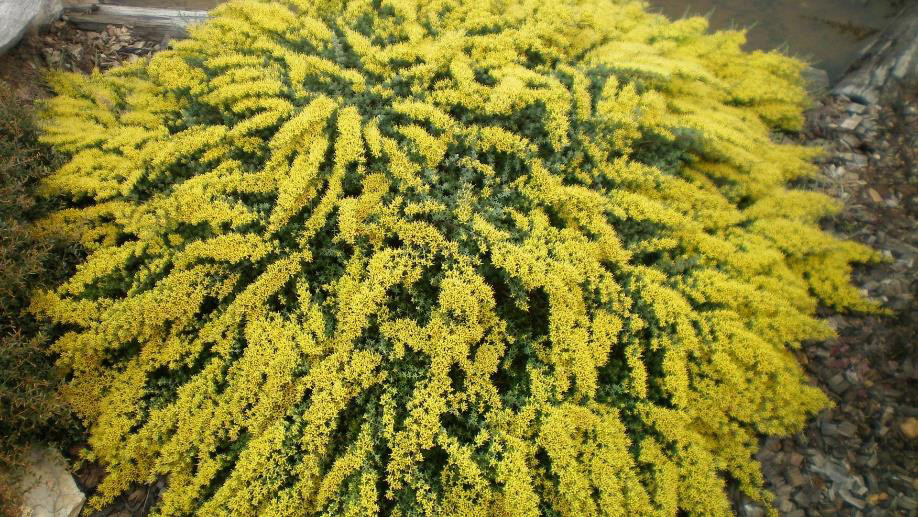
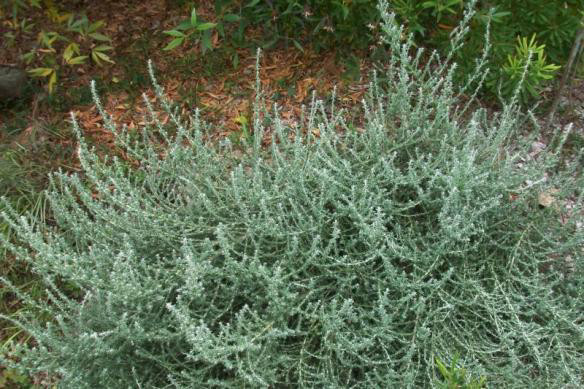
Brian is a member of the Australian Plants Society and has been a keen collector and propagator of Australian plants for more than 40 years. He will speak about native plants with grey foliage.
Olearia lanuginosa ‘Ghost Town’ has wonderful grey foliage and is one of those unkillable plants that thrives in a hot spot with very little demand for water. It’s low growing to around half a metre and, if left to itself, will spread a couple of metres over time. The foliage has a delightful aroma when cut or crushed. It isn’t the small, white flowers that make this plant well worth growing, it’s the silvery, grey foliage that fairly laps up the hot sun. An added bonus is that its cuttings strike with ease.
On a trip out through Broken Hill to the Flinders Ranges, Brian could only look in awe at the great swathes of blue-bush, Maireana oppositifolia and M.sedifolia, that adorned the hot and often rugged countryside.
A wonderful new plant was discovered in the wild near Inverell NSW by members of the APS Grevillea Study Group. They were on the prowl for an elusive grevillea when they spied a stunning, yellow-flowering plant. Keyed out back at the Sydney Botanic Gardens it was found to be Homoranthus prolixus, which had apparently never before been brought into cultivation. It has wonderful blue/grey foliage with red stems on the new growth and stunning bright yellow flowers across the horizontal growth in late spring and early summer. Growing naturally on granite outcrops in an extreme climate, this is yet another great plant that copes with our topsy-turvy climate.
Brian’s been growing Conostylis aurea for many years with wonderful results. It’s a low clumper to around 20cm high with very grey foliage and masses of yellow flower stems from late autumn through until early spring. It really is a stunner and is as tough as anything in the garden. There are so many other wonderful grey-foliaged native plants that thrive in hot, dry conditions once established, and one worth mentioning is Senna (formerly Cassia) artemisioides. This plant has beautiful, intricate, almost lace-like grey foliage with contrasting yellow pea flowers from autumn through to summer. It produces copious amounts of seed that can be germinated easily with hot water treatment.
So, when searching for native plants to cope with hot and dry conditions, don’t forget our amazing greys – how sweet the ground that sees a stretch of these. Brian will help us with our search.
He will bring along some ‘amazing greys’ that you can buy too!
Muogamarra Nature Reserve in August
Ricki Nash
There are 900 species of amazing wildflowers at Muogamarra Nature Reserve, and we hope to be able to get there to see this colourful display of waratahs, native orchids, pink eriostemons and boronias. There is also plenty of wildlife and great views over the Hawkesbury River.
The Reserve is about 3 km north of Cowan and is only open for 6 weeks a year between August and September. To gain access, we have to pre-book either a guided tour with one of the experienced NPWS volunteers or a self-guided tour. Self-guided tours apparently occur on any of the Sundays the Reserve is open and a few select Saturdays.
Our group is looking at booking a self-guided tour either on Saturday, 23rd August or Sunday, 24th August.
As bookings open in mid- June, could members who are interested in coming along please send your names and contact details to me as soon as possible via one of these methods: –
- email- nashj_e@bigpond.com, or
- ring and leave a message or send a text message to 0419 626 848
As I’m unsure of the cost at the moment, once we make the booking, there may be some information regarding payment on the website, and I’ll let you know.
Interesting links
Beetles and other brilliant bugs are nature’s unsung pollinators – from The Conversation.
Lord Howe Island’s famous Kentia palms challenge Darwin’s evolutionary theory – from The ABC.
Secret life of Australia’s ants, the hardest workers in any backyard – from The ABC.
Garden stores selling plants that could be Australia’s next invasive weeds – from The ABC.
Growing Waratahs
Jim Hoffman
This is my reply to Grahame Forrest’s letter in the April 2025 Calgaroo.
The photos are from last September.

I live in North Carlingford and have very heavy clay-based soil.
In 2010, I made a large mound, about 3M by 5M, about 0.5 M above ground level.
I bought a load of washed river sand and mixed it with the existing topsoil – about 50% sand and 50% soil.
A few years later, I planted four waratahs (Telopea speciossima) at one end and three at the other end. Around them, I planted many small banksia species such as B. blechnifolia, B. ‘Coastal Cushion’, B. ‘Honey Pots’ and B. ‘Birthday Candles’. I covered the mound with leaf mulch, some of which came from around a large Banksia serrata.
During the drought, some of the waratahs died. I think the mound might have been too dry for them. Three waratahs are still there.
I got a few good flowers last year, as you can see from my photos.


Nadgee Coastal Walk
Andrew Cox
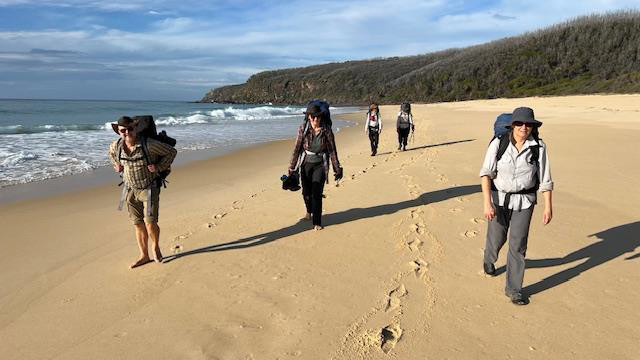
We selected Nadgee Coastal Walk for our Easter 2025 bushwalk because we wanted to find a location roughly midway between our home in Katoomba and our friends who live in Melbourne. We both had about a 7–8-hour drive to reach it. And because it was incredibly spectacular, remote, and rich with wildlife.
Completing the walk in four days was feasible without rushing. We arranged Dale from Mallacoota Cruises and Ecotours to take our party of 6 by minibus from our cars at the walk’s end in NSW to Mallacoota in Victoria, to ferry us across the deep channel at Mallacoota Inlet and drop us at Big Beach in Croajingolong National Park and the start of our 55km trek.

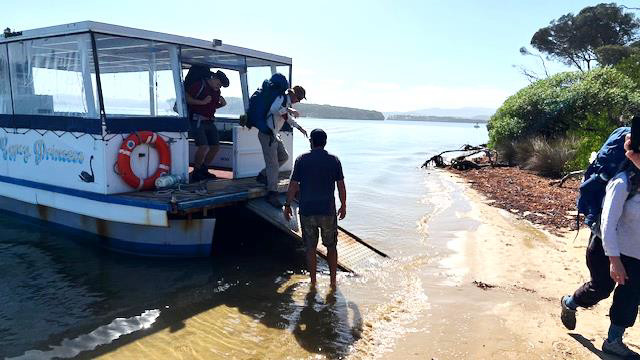
Leaving the boat transport that crosses Mallacoota Inlet
The first day and a half was beach walking, with the first overnight stop at Lake Barracoota, a large freshwater lake isolated from the coast by a collection of exposed dunes. On the beach, we spied large flocks of feeding red-capped and hooded plovers, sooty and pied oystercatchers, and occasional sea eagles. Further dunes to the north added to the feeling of isolation and dryness. Drinking water was scarce, with a brackish but drinkable Lake Wau Wauka and a few small soaks the only reliable water sources.
Once we crossed the NSW border at Conference Point and Cape Howe to enter Nadgee Nature Reserve, small rocky cliffs emerged, adding to the variety. The state border at this point is a straight 180km line from the source of the Murray River to near Cape Howe, with the surveying party in the early 1870s emerging at the coast to within 43cm of the target at Conference Point. The proclamation of the border was not officially completed until 2006 due to a failure to sign the official paperwork at the time. See the Wikipedia article here.
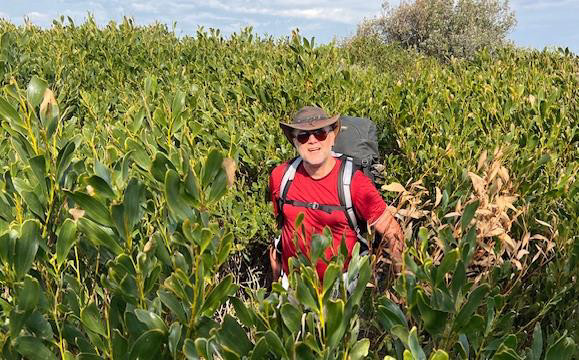
Further north, the track headed inland at times through low, stunted heathland. While it burned fiercely in the Black Summer bushfires of 2019-20, the vegetation has recovered well, absent some larger scattered trees and bushes. Before the fires, much of the heath was knee-high, with a diversity of wind-battered bonsai grevilleas, banksias, and hakeas. One of the excitements for the birders amongst us was flushing out numerous ground parrots, an elusive, threatened species.
The second campsite was the delightful but salty Nadgee Lake, blocked from the ocean by an intermittently opening beach, while subsequent landmarks were Nadgee Beach and Nadgee River, Impressa Moor, Little Creek, and Newtons Beach, our final night’s camp. The walk ended at the car park at Merrica River Crossing, where day visitors can walk either to Newtons Beach or the Merrica River entrance.
Overnight walks require a permit from the NSW NPWS Merimbula office, with party sizes capped at 8 and total visitor numbers limited due to the scientific and conservation value of Nadgee Nature Reserve, NSW’s largest undisturbed coastal catchment and wilderness.
This is a special part of the NSW coastline, and we can rest assured that its management will remain nature-focused.

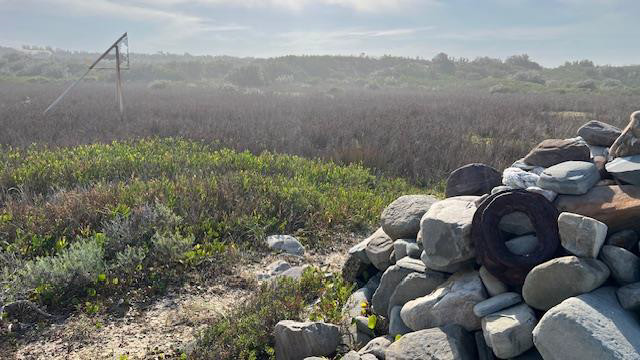
near Conference Point
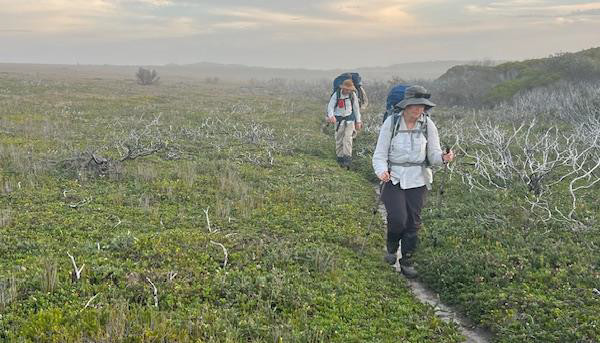
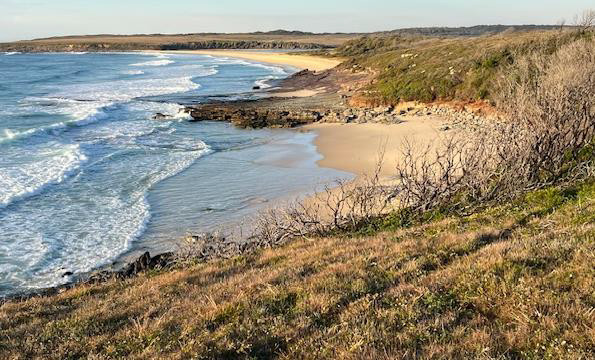
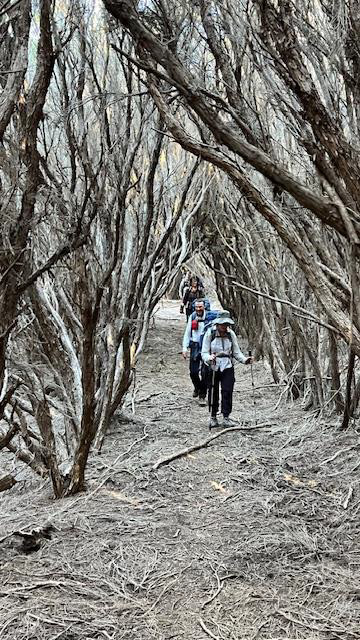

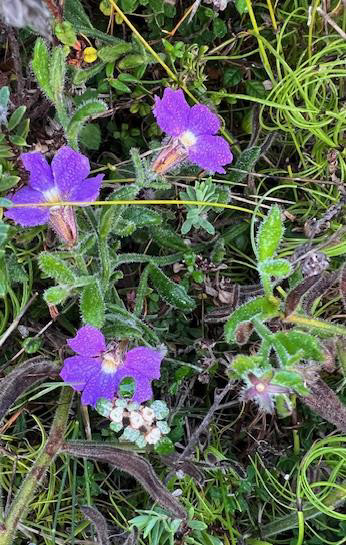
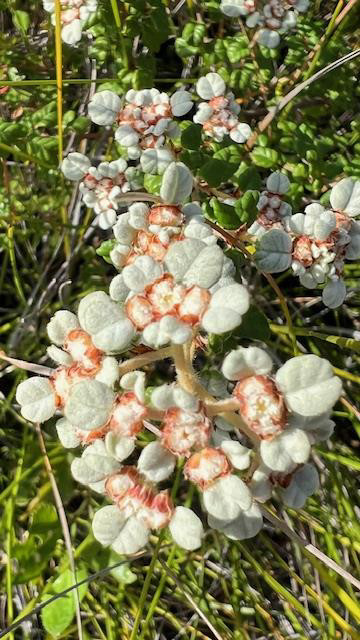
Some of the plants we saw:



Syzygium australe ‘Straight and Narrow’
Ian Cox
About four years ago the NSW Government had a tree giveaway program where you could register your interest in a particular plant and pick it up from Bunnings.
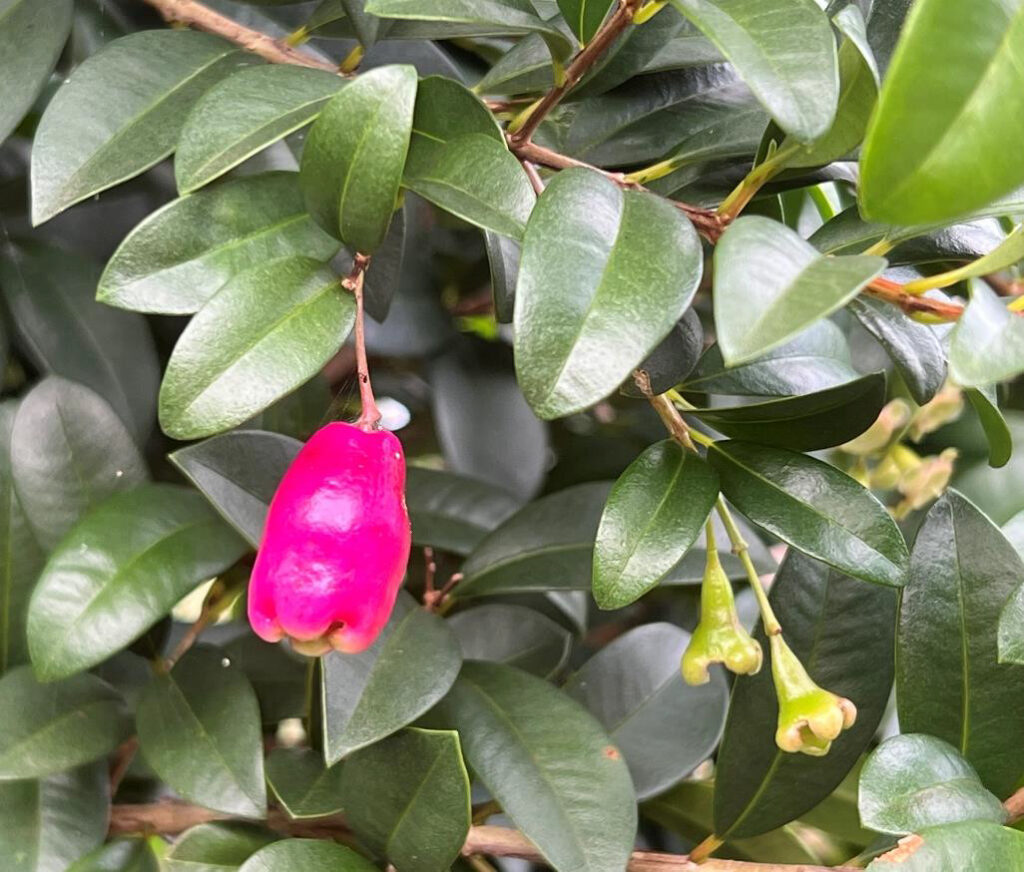
The one I chose was Syzygium australe ‘Straight and Narrow’.
This is what it looks like now in my garden.

It’s about 5.5 metres high and 2 metres wide, growing well in full sun.
In summer, it has fluffy white flowers followed by pink fruit, which are quite tasty, are attractive to birds, and can be used in jams and jellies.
The glossy green leaves maintain a neat appearance throughout the year. The tree is resistant to psyllid attack too.
I recommend this tree if you have a small space in your garden with plenty of height.
A completely new ecosystem has emerged on the Hawaiian island of O’ahu,
composed of a mishmash of species from elsewhere
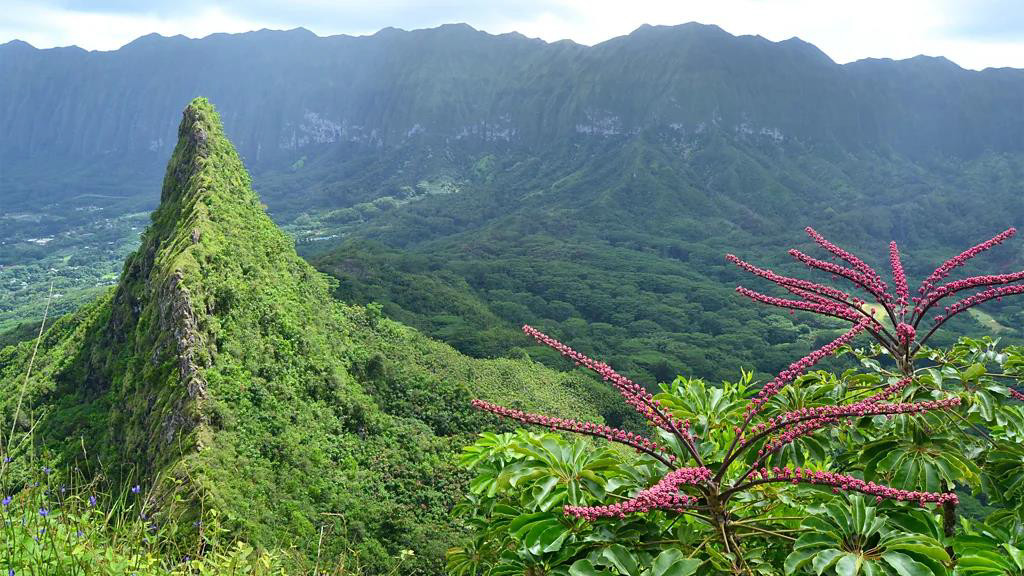
Venture deep into the forests on O’ahu, Hawaii’s third largest island, and you’ll find yourself threading through a dense understory of richly scented pepper, cinnamon and guava trees.
O’ahu’s lowland forests are now almost entirely devoid of the plants and animals that grew here for millions of years before the arrival of humans. Settlers brought extinctions by cutting down trees to make farms and introducing voracious predators and disease-carrying animals.
Today, these tropical forests are a tapestry of non-native species introduced from every corner of the planet: Brazilian peppertree, Indonesian cinnamon and roseleaf bramble from the Himalayas and Australia. Most of the animals are also alien.
Ecosystems which have never been seen before are being accidentally created by humans. They offer a stark look into the nature of tomorrow.
Invasive species
Deliberately and accidentally, humans have introduced countless species of animals, plants and other organisms to non-native biomes. While most new additions are innocuous, more than 37,000 species have been found to harm native species, habitats and ecosystems, causing them to be labelled invasive, according to the United Nations’ Intergovernmental Science-Policy Platform on Biodiversity and Ecosystem Services (IPBES).
Globally, invasive non-native species are one of the top five drivers of global biodiversity loss, according to IPBES, contributing to 60% of global extinctions and causing damages worth $423bn (£323bn) per year.
To continue reading this article from the BBC please click here.
Solanum aviculare (Kangaroo Apple)
Steve Douglas
Photos: Wikimedia Creative Commons
There are several bird species that I’ve seen using Solanum aviculare (Kangaroo Apple) – a silly common name because they aren’t apples or remotely like them, nor are they used by kangaroos. The reference to kangaroos apparently relates to the leaf shape resembling (very vaguely) a large kangaroo footprint. They’re actually Solonaceae, so are better described as a ‘bush tomato’.
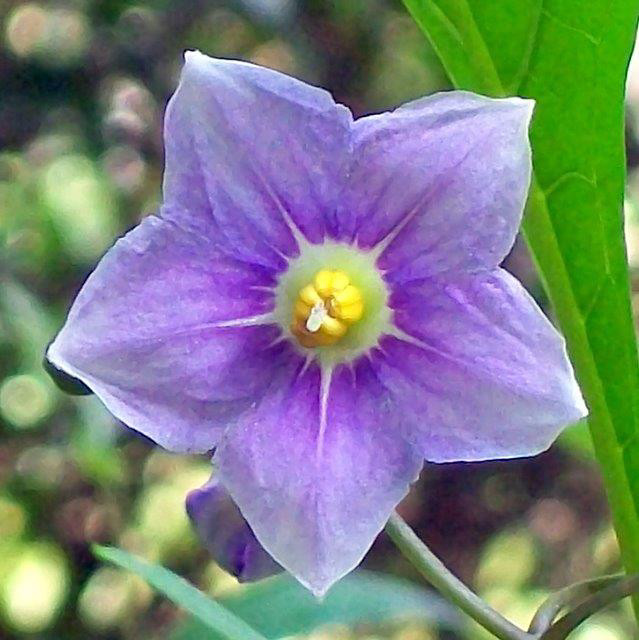
Satin Bowerbirds love the abundant fruit and perhaps the flowers, as do King Parrots, Crimson Rosellas, and Pied Currawongs (which I try to discourage). Yellow-tailed Black Cockatoos showed up recently and weren’t interested in the fruit, but did rip into several branches in search of wood-boring grubs that can be abundant in these shrubs when they’re getting old, which is about 5 years.

These shrubs are often dismissed as weeds because they have a somewhat weedy tendency to come up after disturbance, including fire. They’re indigenous here in the Southern Highlands and have a significant ecological role, not just in quickly providing cover and food in disturbed areas, but they also generate a lot of leaf litter, especially when stressed by heavy fruiting. As they collapse due to their ‘live fast, die young ecology’, they provide food for grubs and lots of small hollows in their stems for use by other insects, then as woody debris that shelters other seedlings.
They’re a good pioneer species for regeneration and replanting, and unlike Pittosporum undulatum, which is sometimes promoted as a pioneer and to exclude non-native plants, it is relatively short-lived and is suppressed by forest canopy. It doesn’t appear to be allelopathic, unlike P. undulatum, which can outcompete almost any ground and mid-stratum species in dense stands. It’s more like the feral Solanum mauritianum (Wild Tobacco) that is still promoted by rainforest regenerators in some areas because it functions as a ‘nurse plant’ in sheltering sensitive seedlings. That species is also shaded-out eventually by rainforest or heavy Wet Sclerophyll Forest cover, and is relatively short-lived, but it also spreads very readily into areas where it continues to grow in higher-light environments.
HARBOUR GEORGES RIVER Group of APS NSW
and Canterbury Bankstown Council Bush care team
Invite you to
the Great Garrison Point Treasure Hunt
Saturday 14th June from 10 am
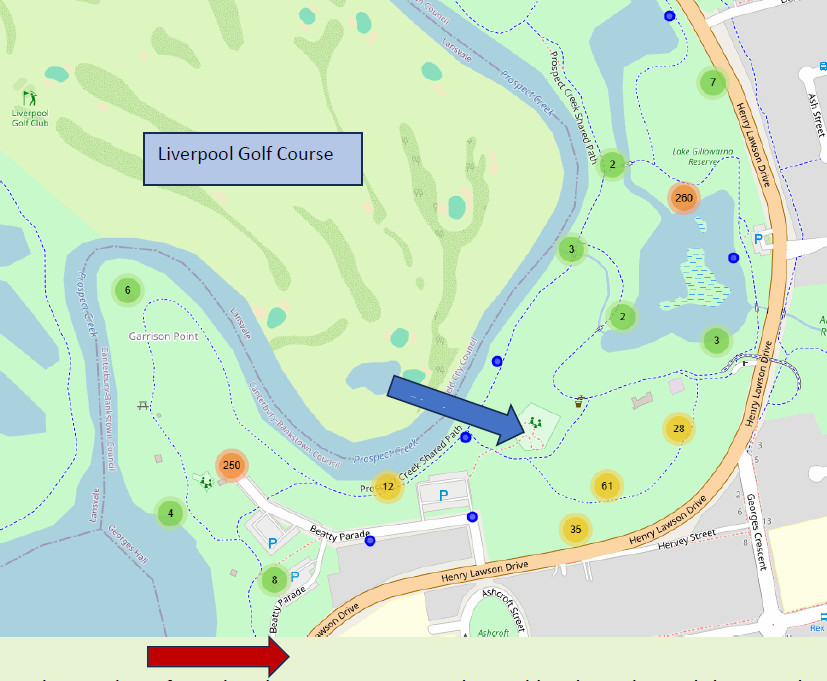
We have a list of 200 local native species, indicated by the coloured dots on the map. How many do you know? How many can you find?
Garrison Point Reserve is between Prospect Creek and Henry Lawson Drive at Georges Hall, about half way between the A22 (Hume Highway) & A34 (Canterbury Rd etc).
You enter from Henry Lawson Drive – the Southern end of Beatty Parade – red arrow [note Beatty
Pde is one way]. There is signage and ample parking. Meet in the Picnic Area (blue arrow) to get your map and list.
Please let us know if you are coming by email to Dorothy dlutherau@yahoo.com.au or on Facebook
https://www.facebook.com/groups/1328674687627886
There is a sausage sizzle lunch provided by Canterbury Bankstown Council, but only if you reply.
https://drive.google.com/drive/folders/1sdpAaKlr0mKjVuDSCY2GLm8EXnjf0yOw?usp=sharing cheat
sheets so you can study up.
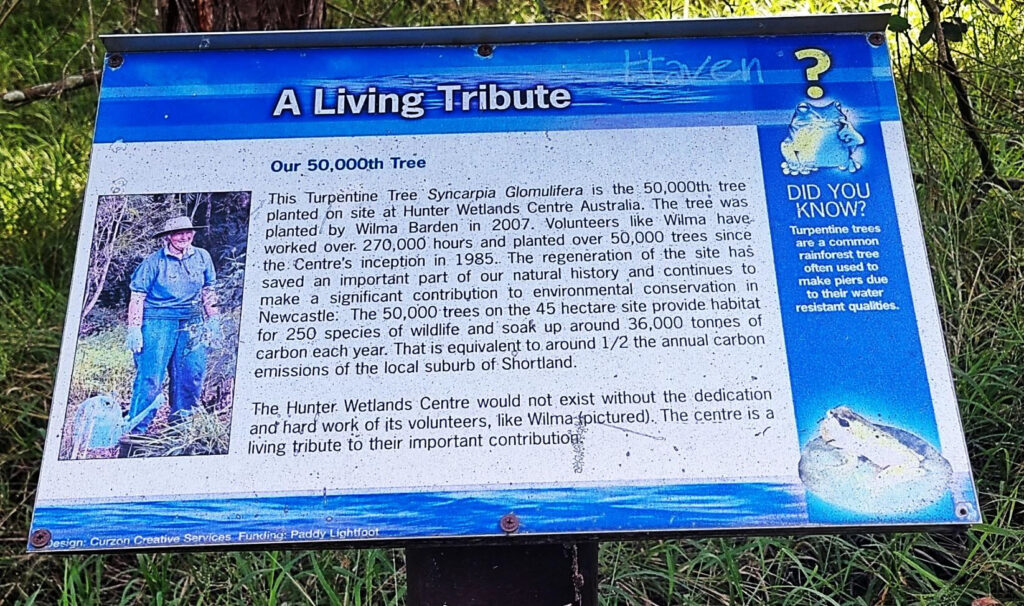
Three cheers for the wonderful volunteers at the Hunter Wetlands Centre!!
Waterfall Walk Bidjigal Reserve 24 May 2025
Jennifer Farrer
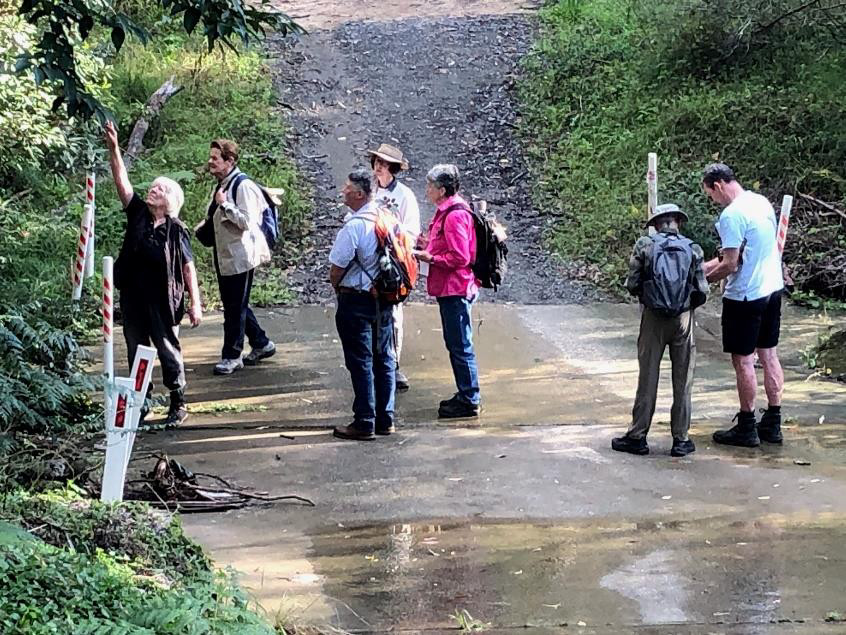
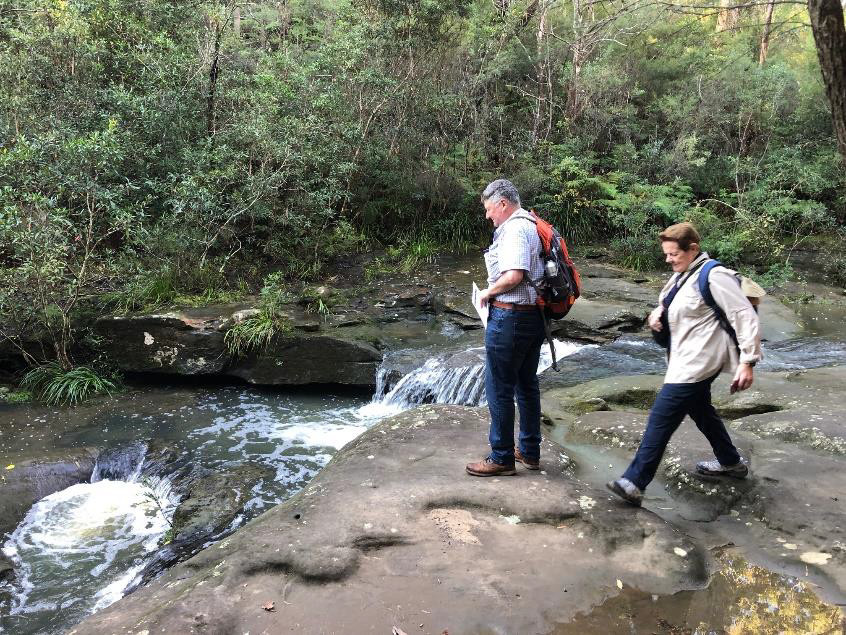
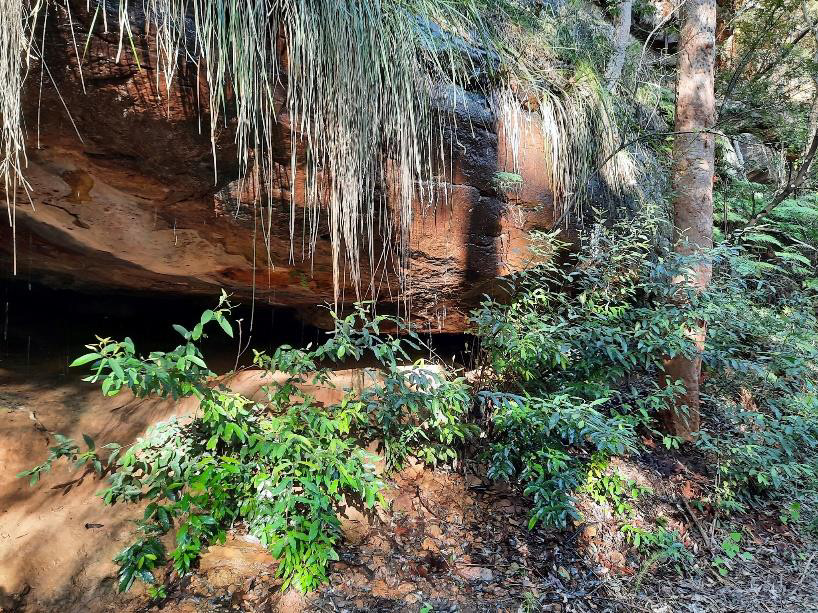
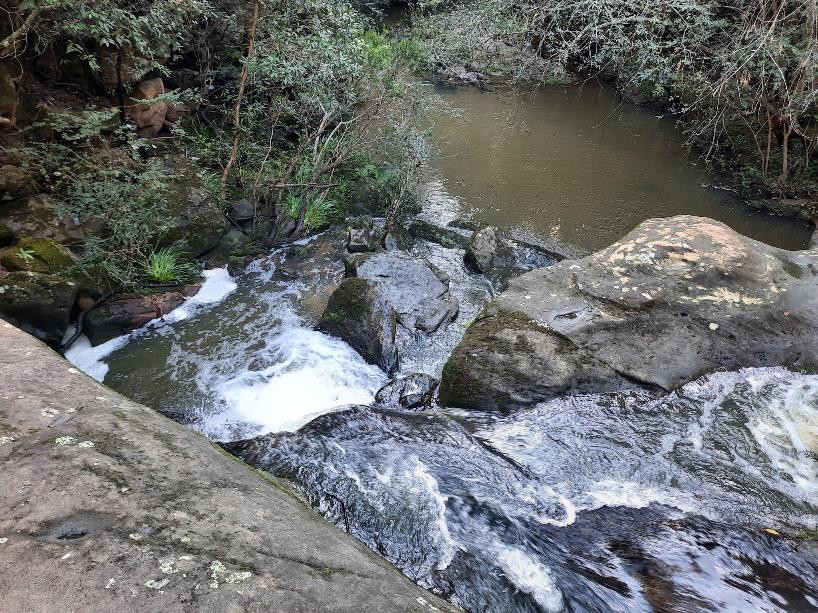
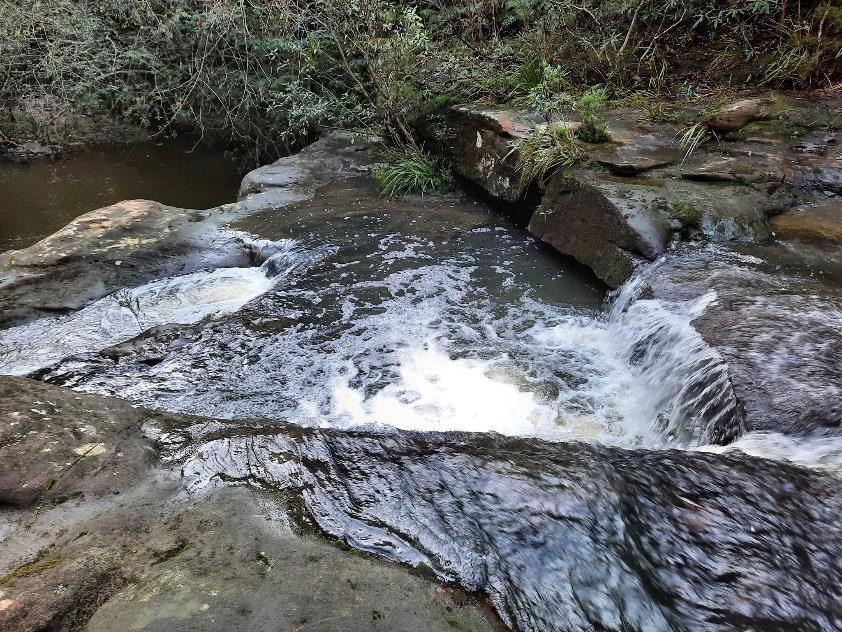
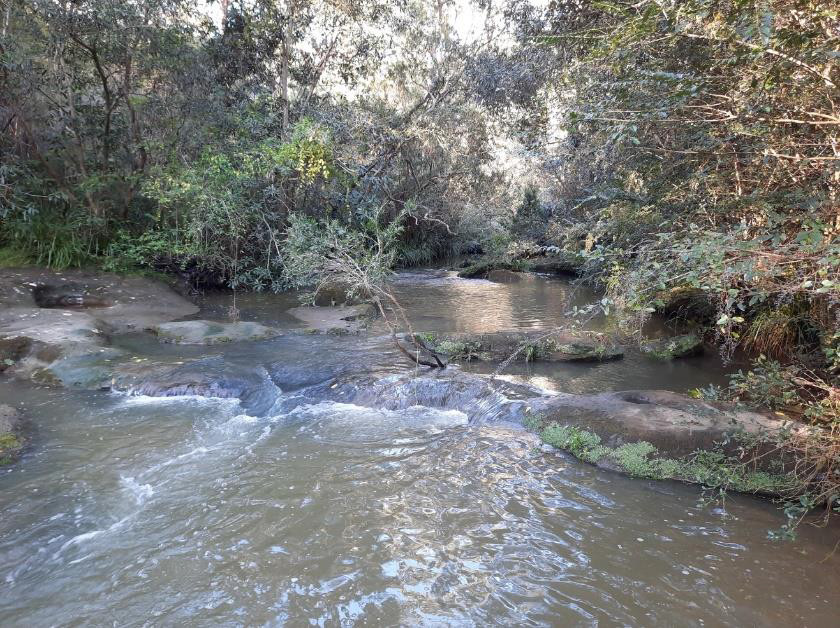
Eleven members met to walk this 3.1 km walk through the northern end of Bidjigal Reserve at West Pennant Hills. There had been heavy rain until the day before but the sun shone for us and we managed to dodge the puddles on the fire trail. We were rewarded with cascades on Darling Mills Creek and a large volume of water coming over the waterfall.
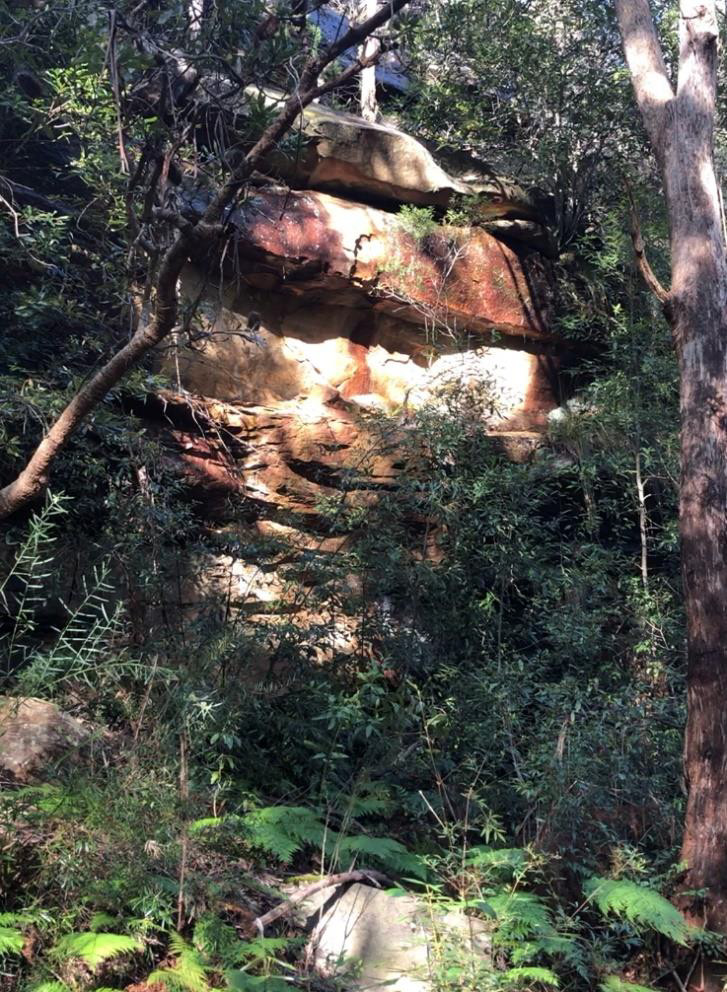
The walk starts in remnant Blue Gum High Forest and then descends into Sandstone Gully Forest. At the lowest point on the track the sandstone cliffs are quite impressive. At the base of the cliffs there are dense stands of Christmas Bush and Callicoma. The track then opens out into Sydney Peppermint Gum Woodland before crossing Blue Gum Creek where more Sydney Blue Gums can be seen.
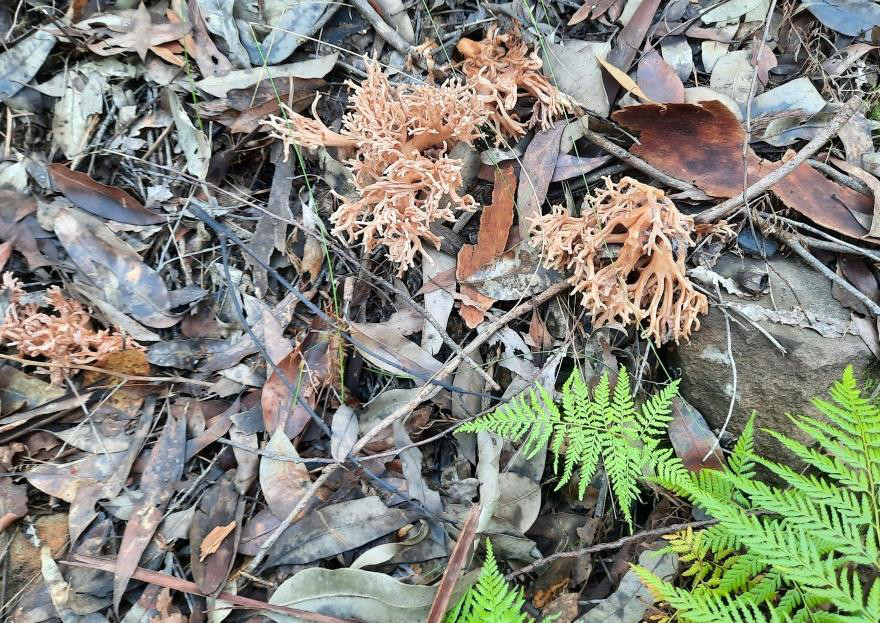
With such a variety of plant communities we easily noted 50 different species. However, after so much rain in the previous two weeks there was also a very impressive range of fungi on show. Unfortunately, our expertise did not extend to identifying many of them but we all decided we were not going to gather any to make Beef Wellington for dinner.
The walk ended at Linda Pine’s home nearby where we enjoyed the outlook of more Blue Gums from her back deck and delicious Lemon Myrtle biscuits.
Many thanks to Linda for her hospitality and to Jim Nash and Linda for their lovely photos.



Share your stories . . .
Your contributions to Calgaroo are always welcome.
If you have interesting observations of plants in the garden or the bush, photos, or any other news, please send them to me at itcox@bigpond.com for the next edition.
* * * * * *

In the spirit of reconciliation, we acknowledge the Traditional Custodians of our Country, the people of the Dharug Nation, whose cultures and customs have nurtured, and continue to nurture, this land since time immemorial. We honour and celebrate the spiritual, cultural and customary connections of Traditional Owners to Country and the biodiversity that forms part of that Country.
* * * * * *

Parramatta and Hills District Group
SECRETARY: Jennifer Farrer apsparrahills@gmail.com 0407 456 577
EDITOR: Ian Cox itcox@bigpond.com
Join us on Facebook here
Join us on our websibsite here